




The West’s religious illiteracy and its geopolitical consequences
A growing lack of religious literacy in the West is distorting policy decisions, from geopolitical strategy to internal social cohesion.
In a nutshell
-
-
-
-
-
-
-
-
-
-
-
- Western policy often ignores religion as a key political driver
- Declining religious literacy weakens societal cohesion
- Misreading religious dynamics leads to geopolitical missteps
-
-
-
-
-
-
-
-
-
-
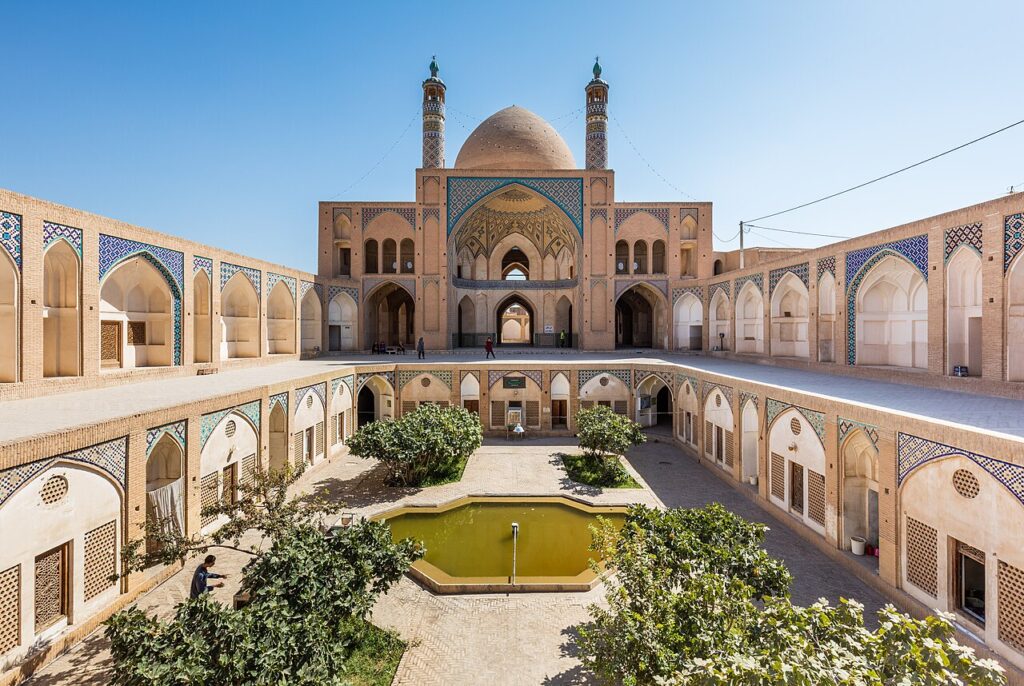
After the missiles began flying across the Middle East on February 28, 2026, when Israel and the United States launched their military campaign against Iran, Tehran responded by indiscriminately pummeling targets across the region. Except for the Israelis, few Western leaders grasp one of the key motivations for Iran’s regime. The mullahs espouse an end-of-times theology within Shia political Islam that eagerly awaits the return of the “12th Imam,” known as the “Mahdi.” To prepare for this return, they see the need for a final battle of apocalyptic proportions, in which the U.S. (“the great Satan,” as they call it) features prominently.
It has become clear that new hardline Iranian leaders are now taking control. A recent study by Fox News Digital titled “Chasing the apocalypse: Radical Shiite clerics on American soil preach prophetic showdown with U.S.” outlines how in recent decades, certain Shia mosques and organizations in the U.S., which are sponsored by or linked to the Iranian regime, have been openly preaching apocalyptic interpretations. Recently, in northern Virginia, one such imam publicly prayed, “May Allah destroy all the nonbelievers.”
Another thoroughly researched analysis by the Institute for the Study of Global Antisemitism and Policy outlines in detail how the (Sunni) Muslim Brotherhood has, for over 50 years, pursued a “comprehensive, multigenerational strategic campaign to transform Western society (especially in the United States) from within, through what its own internal documents describe as ‘civilizational struggle’ (jihad).”
It goes on to explain that “[u]nlike conventional terrorist threats, this strategy exploits democratic freedoms and institutions to advance fundamentally anti-democratic objectives, representing a sophisticated form of nonviolent extremism targeting Western democracies.”
Religion as a strategic blind spot
What most Western leaders do not understand is how deeply intertwined religion and society are outside of their own secular bubble – a bubble in which disdain or incomprehension toward people and traditions of faith is often the norm. This prejudiced attitude poses a major handicap for Western powers, directly affecting both their domestic and geopolitical decisions.
Western elites in government, the economy, the media and education are simply incapable of addressing religious questions in an informed and rational manner, and therefore do not see how this is weakening their democratic societies at the core. Most of the West has aggressively dismantled centuries of its foundational Judeo-Christian thought and tradition in favor of an insular ideology that rejects religion – any religion – as a relevant force in society.
Western elites in government, the economy, the media and education are simply incapable of addressing religious questions in an informed and rational manner.
Along the way, we have also diminished institutions like marriage, the family, places of worship, confessional schools and religiously inspired associations and public festivals. This militant form of secularism has gradually rendered the state and its institutions – which claim the mantle of a non-existent “worldview neutrality” – blind to the lasting impact upon society of different religious traditions and how to deal with them in each case. As a result, the West has lost its bearings, incapable of developing proper policy on these at times highly volatile and deeply divisive matters. If you do not know who you are, how can you begin to see others for who they are?
Western democracies and their civil societies currently lack the inner, quiet sense of objective moral truth that is nourished by the thousands of years of Greco-Roman and Judeo-Christian thought. The core biblical understanding that there is a God, and that I am not him, yet created in his image, has unfortunately not prevented unspeakable injustice, bloodshed and destruction. However, this notion of human dignity has, time and again, helped Western societies finally step back from the brink, recognize their follies, learn from them and move on with trying to build a slightly better world. In doing so, we have come far, with enormous advances in justice, freedom, science, technology, prosperity and other areas of which we count the many blessings today.
Ultimately, the West became arrogant in its apparent success in ruling over nature. As a result, it deemed the transcendent and unchangeable moral principles of human dignity, from which its success was built over the centuries, a relic of the past that could be discarded for good. How wrong they were, now unable to understand how religion and morality affect people, culture and places.
Westerners, especially their 21st-century ruling classes, have become so religiously illiterate that they lack the necessary intellectual tools, and often even the willingness, to deal with religion and faith in a nuanced and honest manner by means of investigative interest. In the process, they tend to ignore the different approaches each religious system has to the question of how to interact with the societies in which they operate.
Consequently, people fail to distinguish between the normal exercise of religion and the misuse of that same religion for political ends. A case in point: Some green and far-left groups and individuals across the West have been cooperating, especially during recent public protests, with Islamist movements, not realizing how they and their cause are being used as instruments. Some of the “Free Palestine” protests in Europe and the U.S. are telling examples, as was the March 15, 2026 pro-Iran Al-Quds rally in London. Are these same protesters aware of the punishments that most Islamist ideologues advocate for those having lifestyles symbolized by rainbow flags and pride parades?
On the other side of the political spectrum, we can find different forms of the instrumentalization of religion in political discourse. In 2009, the leader of Austria’s Freedom Party appeared with a large cross during a protest in Vienna against the expansion of a Turkish center. More recently, U.S. Secretary of War Pete Hegseth offered a public prayer at the Pentagon calling for “overwhelming violence of action against those who deserve no mercy.” This raises the question – independent of the just or unjust war discussion to be had – of whether the use of such religious language and debatable theological interpretation is appropriate for a senior cabinet member who identifies as a Christian. Pope Leo XIV certainly seemed to answer this question when on Palm Sunday he preached: “this is our God: Jesus, King of Peace, who rejects war, whom no one can use to justify war.”
The age of substitute religions
Fundamental differences
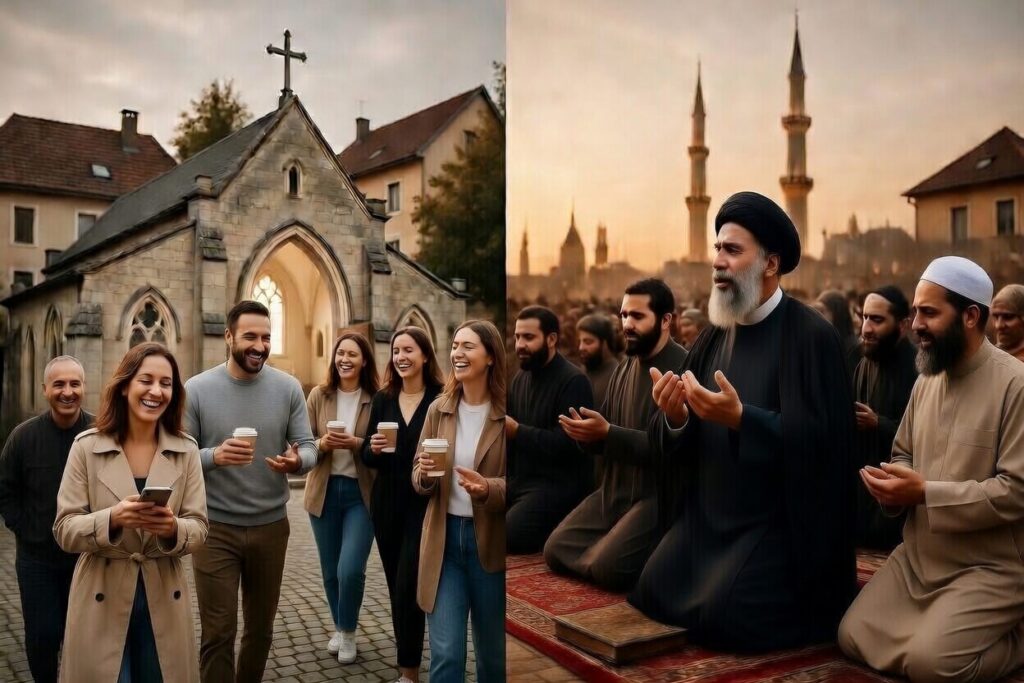
The West rightly respects and defends people and communities of all faiths enjoying freedom of religion. This is a cornerstone of our societies that must always be upheld. However, most political and civil society leaders fail to see that not all religions and their followers now present in our societies share the same understanding of religious freedom as derived from the Western tradition, even while making full use of it.
The place and role of religion in society are fundamentally different in Islam and Christianity, for example. By definition of its sacred texts and tradition, Islam is not only a religion but also a complete political, legal and compulsory normative system that every good Muslim is required to help implement – everywhere and by all means necessary. Christianity, on the other hand, based on holy scripture and tradition, invites its followers to freely live according to its proposed principles amid the rest of society, without either presenting or imposing a specific political, legal or compulsory moral order.
In other words, Christianity, because of its outlook on human freedom and flourishing, does not wish to impose onto society a so-called “revealed legal order,” whereas Islam explicitly wishes to do so through Sharia law.
In his speech to the German Parliament in 2011, Pope Benedict XVI noted this when he said: “Unlike other great religions, Christianity has never proposed a revealed law to the State and to society, that is to say a juridical order derived from revelation. Instead, it has pointed to nature and reason as the true sources of law.”
Throughout history, misguided Christians or those claiming to be Christian rulers have tried to impose models of government that fail to separate church and state. However, unlike with Islam, they cannot base such actions on scripture or authoritative tradition. We in the West must understand this vital difference if we want to live peacefully with a rapidly increasing number of people who choose to live according to Islam and its cultural norms, even if they are not all necessarily practicing Muslims.
The domestic danger for Western society does not lie in respecting the same freedom for all religions, but rather in its stubborn refusal to see and honestly address the challenging realities that exist and will only grow because of those unaddressed differences.
This is clearly illustrated by the lasting consequences of then German Chancellor Angela Merkel’s infamous 2015 slogan “Wir schaffen das” (“We will manage it”). Her government invited nearly 1 million Syrian, Iraqi and Afghan asylum seekers into a country that, due to its own identity crisis, even when genuinely willing, is not capable of properly integrating such a large group of predominantly Muslim migrants. This came full circle when on March 30, 2026, Germany’s Chancellor Friedrich Merz at a press conference in Berlin with Syrian President Ahmed al-Sharaa expressed the hope that 80 percent of the Syrians in Germany will return home in the next three years.
More worryingly, the religiously illiterate do not understand that political Islam as an ideology weaponizes the state against its citizens, using religious rules to limit freedom of religion and of expression, thus undermining the Western way of life. Here we also see the ongoing efforts by Western governments to limit or even ban public debate about this threat.
Miscalculations and their consequences
Geopolitically, all this has led Western powers to unsuccessfully try to impose concepts such as democracy and the rule of law on countries that have a fundamentally different understanding of how society should be organized and ruled, not only from a historical-political perspective, but also from a deeply religious one. The West’s failed interventions in the Middle East and Afghanistan are a telling example and show its lack of understanding and respect for religion in general.
For an observant Muslim, and even more so for those espousing political Islam, the idea that his or her religion is a purely private affair and has no place in the public square is completely foreign, even heretical. Hold that against the empty Western paradigm that religion has no place in that same public square, while society’s leaders largely have no clue as to the nuances and implications of religious-cultural traditions in their societies. It is clear who may eventually gain the upper hand.
It is unlikely that what we in the West know as democratic pluralism and freedom will be part of that outcome. We can see how this has played out since 1979 in formerly secular Iran. Still, religious fundamentalism is not the West’s bigger threat – religious illiteracy is. It is time to recover our literacy. We can do this by accepting who we are and once again knowing our history – with all its ups and downs. Let us embrace the enduring sources of wisdom that have shaped Western civilization.
Author: Christiaan Alting von Geusau – attorney
Source: https://www.gisreportsonline.com/r/west-religious-illiteracy/