

AI, federalism, and the new economic power
The future of wealth will not be centralized: AI will not simply transform work, but will redefine who holds control over wealth.
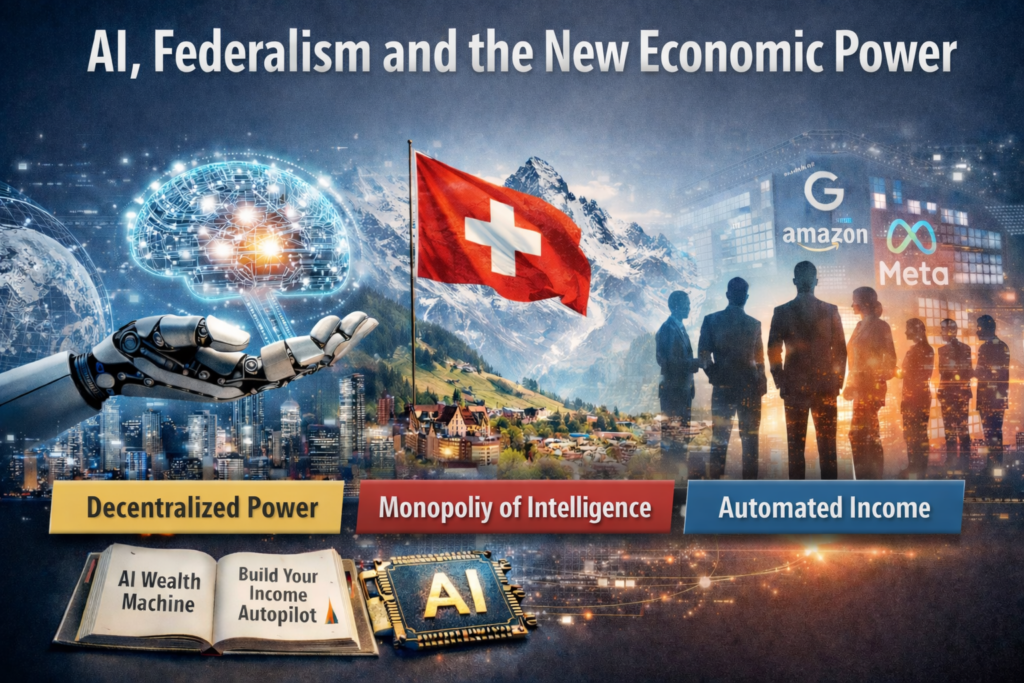
In a world where artificial intelligence no longer merely assists but begins to make autonomous decisions, the fundamental question is not what AI will do.
The real issue is far deeper: who will own the systems that guide it?
AI is not technology. It is an architecture of power
The dominant narrative portrays AI as a tool, an assistant, a simple productivity accelerator. But this is a superficial view. AI is, in reality, a decision-making infrastructure: it analyzes data in real time, optimizes capital allocation, makes operational decisions, and generates cash flows. In other words, AI is becoming an autonomous economic system. And like any economic system, it creates winners and losers.
The invisible advantage of Switzerland
In this scenario, Switzerland starts from a unique position. Not because of technology. Not because of size. But because of its structure: federalism.
A system that distributes power, multiplies decision-making centers, and accelerates adaptation.
In a centralized world, decisions are slow, innovation is controlled, and risk is concentrated.
In a federal system, by contrast, experimentation increases, adaptation is faster, and risk is distributed.
This is exactly what is needed in the age of AI
👉 Switzerland does not need to adapt to AI. It is already designed for it.
The real risk: the monopoly of intelligence
As AI advances, a new concentration of power is emerging: Big Tech controls the models, governments attempt to regulate, and platforms centralize data and decision-making processes.
The result is increasingly clear:
👉 an unprecedented concentration of cognitive power
A possible “monopoly of intelligence.”
And like any form of monopoly, this development carries a structural risk: reduced freedom, slower innovation, and a diminished distribution of opportunities.

The new paradigm: AI + the individual
The real revolution lies not in using AI tools, but in building AI-based systems capable of generating value autonomously.
It means shifting from a model where work generates income to one where the system itself produces automated income.
In practice:
automating decisionsbuilding digital cash flowsscaling without increasing human costs
👉 it’s not about working with AI, but about designing systems in which AI works for you
AI Wealth Machine – strategies for the work and income of the future
The CFO of the future
This shift also profoundly redefines the role of finance.
The traditional CFO focuses primarily on cost control, budget validation, and performance monitoring.
The CFO of the future, instead:
- designs autonomous economic systems
- allocates capital toward AI builds cash flow enginestransforms data into automatic decisions, without human intervention
It is no longer about management and control, but about designing systems capable of generating value autonomously.
The decisive question
In five years, the difference will not be between those who use AI and those who do not.
It will be between:
- those who are part of a systemand those who own a system
- For those who want to move now
This paradigm shift is not theoretical. It is already underway.
That’s why I wrote:
AI Wealth Machine – Build Your Income Autopilot
👉 AI Wealth Machine – Build Your Income Autopilot (Amazon)
👉 Also explore the official landing page with free resources