

Former Republics and lost States of Europe: ethnic and religious divisions
Lessons from history for the new identity challenges of the 21st century
The West’s religious illiteracy and its geopolitical consequences
The free Territory of Trieste (1947–1954)
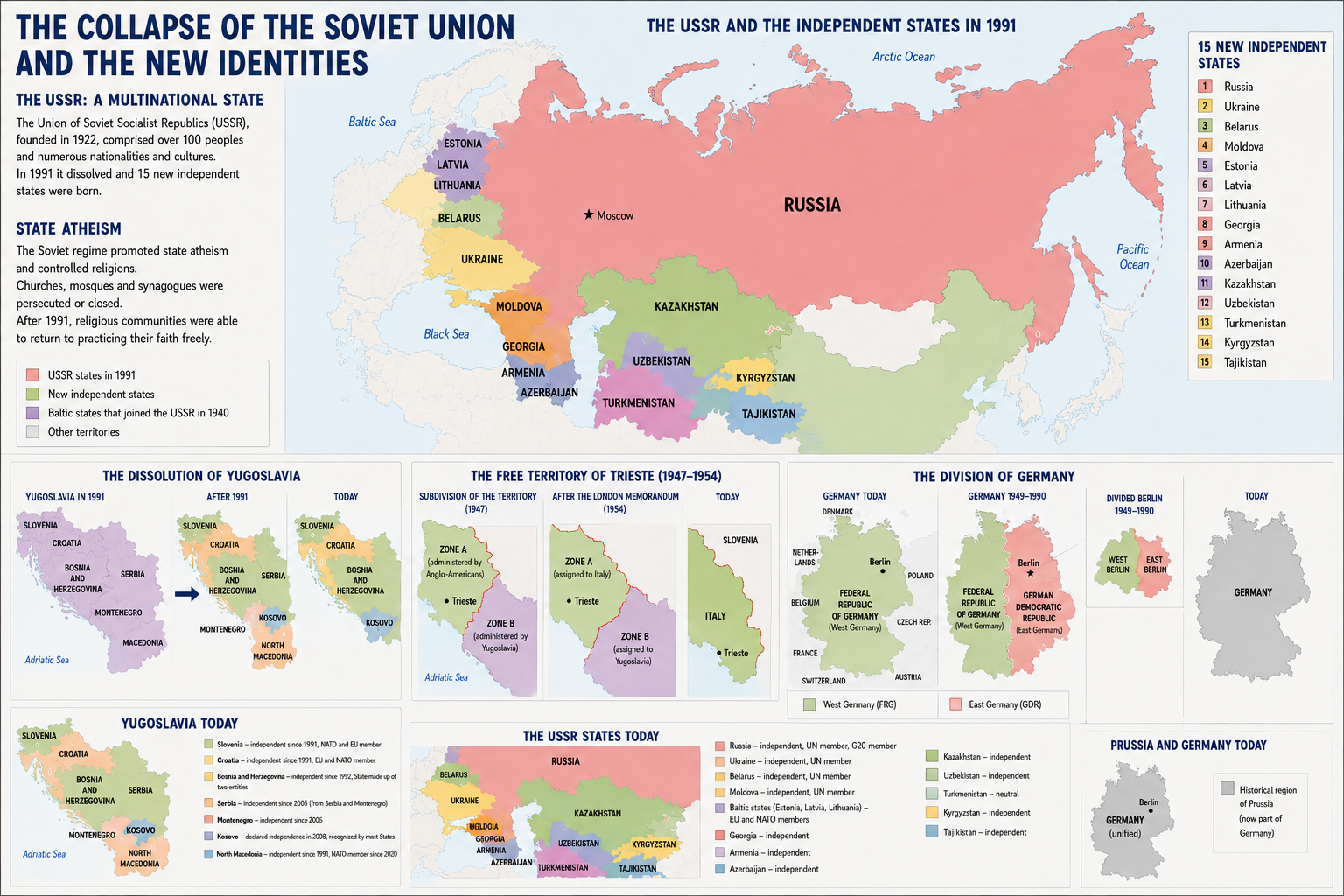
The brief experiment of the Free Territory of Trieste was established in 1947 as a compromise between Italy and Yugoslavia to resolve the dispute over the eastern border after the Second World War. The territory was divided into two administrative areas: Zone A, including Trieste, under Anglo-American control and inhabited mainly by an Italian and Catholic majority; and Zone B, administered by Yugoslavia and home to significant Slovene and Croatian communities.
National divisions overlapped with religious affiliations: the local Catholic Church often became a place where Italian identity was affirmed in Zone A, while in Zone B part of the Slovene and Croatian clergy supported integration into Yugoslavia. Tensions were further aggravated by the wounds left by the war, including the foibe massacres—the killings and disappearances of thousands of Italians and opponents of the Yugoslav regime carried out by the communist forces of Josip Broz Tito—and by the subsequent Istrian-Dalmatian exodus, which forced many Italian families to abandon their homelands.
In 1954, with the London Memorandum, the territory was divided between Italy and Yugoslavia, bringing this hybrid state to an end. The final definition of the border was later established by the Treaty of Osimo. The story of Trieste remains, to this day, a symbol of the complexity of the relationship between national identities, historical memory, and coexistence among different peoples.
East Germany: protestantism, state atheism, and division
The German Democratic Republic (1949–1990) was established in the eastern part of Germany, a region historically characterized by a strong Lutheran Protestant presence inherited from the Reformation initiated by Martin Luther. With the establishment of the communist regime, the state promoted a policy of secularization and official atheism, limiting the influence of churches in public life and discouraging religious participation, especially among young people.
Protestant communities, particularly the Evangelical Church, found themselves in a complex position. Although subjected to state surveillance and pressure, they managed to maintain a certain degree of autonomy compared to other institutions of civil society. Some church representatives cooperated with the regime, while others transformed churches into spaces for discussion, debate, and peaceful opposition.
During the 1980s, several religious communities became gathering points for pacifist, environmental, and civil rights movements. Particularly important were the so-called “Monday Prayers” held at St. Nicholas Church in Leipzig, which contributed to the emergence of the mass demonstrations of 1989 against the communist regime. These protests played a significant role in the events that led to the fall of the Berlin Wall and the subsequent process of German reunification.
With reunification in 1990, the religious differences that had developed during forty years of division became clearly visible. While religious practice had remained relatively widespread in West Germany, many citizens in the East had grown up in a strongly secularized environment. Even today, the territories of the former East Germany rank among the least religious regions in Europe, reflecting the lasting impact of the policies adopted during the communist period.
The Soviet Union: the great religious and ethnic mosaic
The USSR was one of the largest and most complex multinational states of the twentieth century. Within its borders lived numerous ethnic and religious groups: Orthodox Christians (Russians, Ukrainians, Belarusians, and Georgians), Catholics (especially in Lithuania and western Ukraine), Muslims (in the Central Asian republics and the Caucasus, as well as among the Volga Tatars), Jews, Lutherans (in Estonia and Latvia), and many other religious and cultural minorities.
After the Bolshevik Revolution of 1917, the new Soviet state adopted a policy of state atheism and strict control over religion. Under Joseph Stalin’s regime, particularly during the 1930s, campaigns against religious institutions intensified: thousands of churches, mosques, and synagogues were closed or destroyed, and numerous clergy members were persecuted, imprisoned, or deported to the Gulag labor camps. Entire populations accused of “disloyalty” were also deported, including the Crimean Tatars and several groups from the Caucasus.
Despite this repression, religious practices did not disappear entirely. Many communities continued to practice their faith privately or underground. With Mikhail Gorbachev’s policies of openness (perestroika and glasnost) during the 1980s, religion gradually re-emerged in public life.
Religious identities became increasingly intertwined with national aspirations. In the Baltic states, Catholicism and Lutheranism became symbols of independence; in the Caucasus and Central Asia, Islam once again became a central element of collective identity; and in Russia and Ukraine, Orthodoxy strengthened processes of nation-building while also contributing to internal tensions between different ecclesiastical jurisdictions.
These dynamics contributed to the collapse of the Soviet Union in 1991. Fifteen independent states emerged from its dissolution: Russia, Ukraine, Belarus, Moldova, Estonia, Latvia, Lithuania, Georgia, Armenia, Azerbaijan, Kazakhstan, Uzbekistan, Turkmenistan, Kyrgyzstan, and Tajikistan.
Mikhail Gorbachev and a part of history goes away
Conclusion: the new religious divisions of the twenty-first century
The history of the states that disappeared during the twentieth century demonstrates that ethnic and religious divisions, when not managed with realism and determination, can erode from within even the most seemingly solid political structures. Today, Europe faces a new challenge of this kind.
The large-scale immigration of predominantly Muslim populations from the Middle East, North Africa, and South Asia is creating, in many European countries, parallel communities with cultural and religious values that are often at odds with those of the European tradition (whether secularized, Christian, or post-Christian). Phenomena such as rising antisemitism, concentrated incidents of sexual violence, demands for the implementation of sharia law in certain areas, Islamist radicalization, and the formation of enclaves that are difficult to govern suggest that integration is not taking place on a large scale.
These dynamics could generate new identity-based tensions similar to those that contributed to the dissolution of Yugoslavia or accelerated the collapse of the Soviet Union: on the one hand, a European identity that is weakened and hesitant to assert itself; on the other, forms of Islam that, in some of their currents, reject the very principle of separating religion from politics. If European elites continue to ignore or downplay these frictions, there is a real risk that, within a few decades, Europe could witness new social fractures, ethno-religious enclaves, local conflicts, and even possible political or territorial reconfigurations within today’s nation-states.
The lesson of history is clear: borders and states endure only as long as they correspond to the genuine identities of the populations that inhabit them. Ignoring deep religious and cultural differences does not make them disappear; it makes them potentially explosive. Europe’s future will depend on its ability to recognize this reality and to defend its civilization consistently, before new divisions make change irreversible.