

Artificial intelligence and the future of society
From centralization to intelligent decentralization: exploring how AI can enhance local autonomy, foster Innovation, and promote economic freedom.
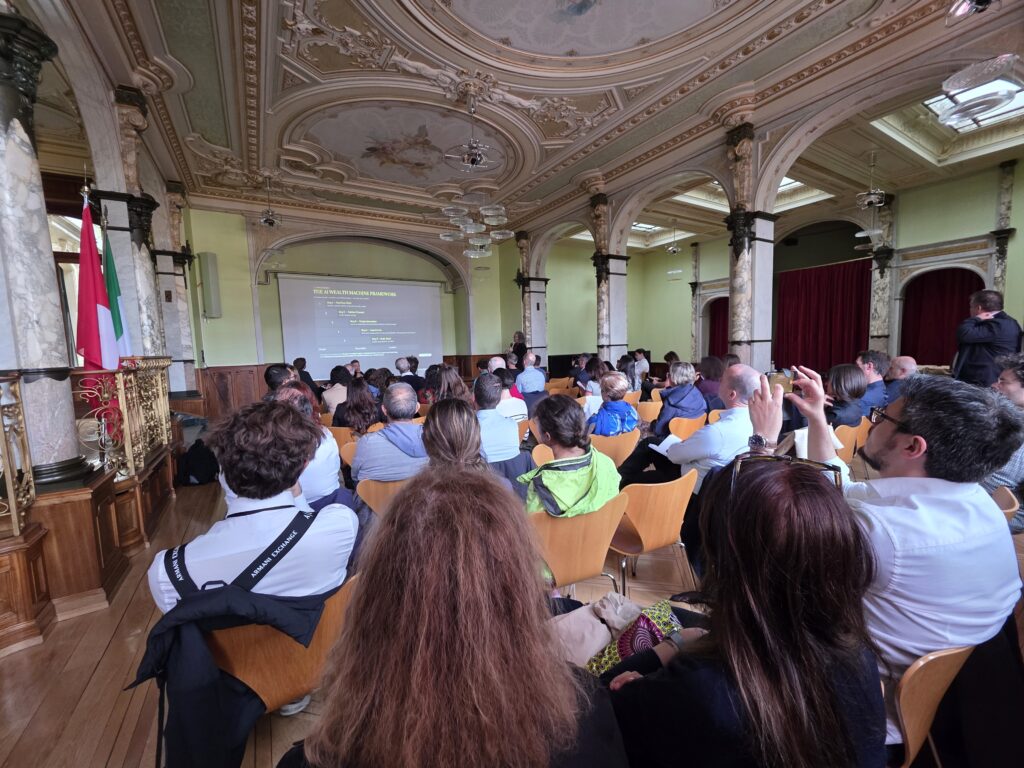
On June 11, 2026, researchers, entrepreneurs, artists, and professionals gathered in Zurich to discuss one of the most important questions of our time: how will artificial intelligence transform our economy, our institutions, the media, creativity, and ultimately society itself?
The occasion was the event AI, Art & Media and the New AI Economy, organized by the Italian Cultural Institute of Zurich (Italiano di Cultura di Zurigo), part of the Italian Ministry of Foreign Affairs and International Cooperation (MAECI).
The speakers included Professor Massimiano Bucchi, a member of the Accademia dei Lincei and Professor of Science, Technology and Society; Dr. Philip Di Salvo of the University of St. Gallen; artist Stefano Cagol, who has participated in the Venice Biennale; Dr. Andrea Schenone, author of the book AI Wealth Machine; and Dr. Raffaele Pentangelo, Director of the Italian Cultural Institute of Zurich, who moderated the concluding discussion.
Throughout the evening, participants explored some of the most significant issues of the digital age: artificial intelligence and democracy, investigative journalism, information security, economic growth, entrepreneurship, public governance, and the future of work.
Among the many topics discussed, one in particular attracted considerable attention: the relationship between artificial intelligence and federalism.
The historical logic of centralization
To understand the potential impact of AI on institutions, it is useful to begin with a simple historical observation.
For centuries, administrative centralization was justified by economies of scale. Managing information, coordinating public services, collecting data, and making decisions on a large scale required extensive bureaucratic structures and highly centralized organizations.
In many cases, centralization was not an ideological choice but a technical necessity.
Modern states expanded precisely because the efficient management of complex systems appeared to require a single decision-making center capable of processing information and coordinating activities across large territories.
Artificial intelligence changes the rules of the game
Artificial intelligence has the potential to fundamentally alter this equation.
For the first time in history, the cost of information processing, data analysis, organizational coordination, and public service delivery can be dramatically reduced.
Intelligent systems and AI agents can assist governments, businesses, and organizations in performing tasks that, until only a few years ago, required entire departments.
If the primary advantage of centralization was the ability to process and coordinate vast amounts of information, AI significantly reduces that advantage.
As a result, smaller and more decentralized structures may become increasingly competitive.
The possible advantage of Switzerland
In this context, Switzerland occupies a particularly interesting position.
Swiss federalism represents one of the most decentralized governance systems in the world. Cantons and municipalities have extensive fiscal, administrative, and political powers, encouraging experimentation, innovation, and local accountability.
Traditionally, some critics have argued that decentralization entails higher administrative costs compared to centralized systems.
However, artificial intelligence could overturn this assessment.
Thanks to intelligent automation, even relatively small administrations could deliver highly efficient services without increasing their size or organizational complexity.
The combination of local autonomy and technological capability could enable:
- greater administrative efficiency
- reduced bureaucratic costs
- faster decision-making processes
- more personalized public services
- greater transparency
- stronger accountability to citizens
In other words, AI could make federalism not only a politically effective model, but also an economically more competitive one.
AI Wealth Machine – strategies for the work and income of the future
From centralized intelligence to distributed intelligence
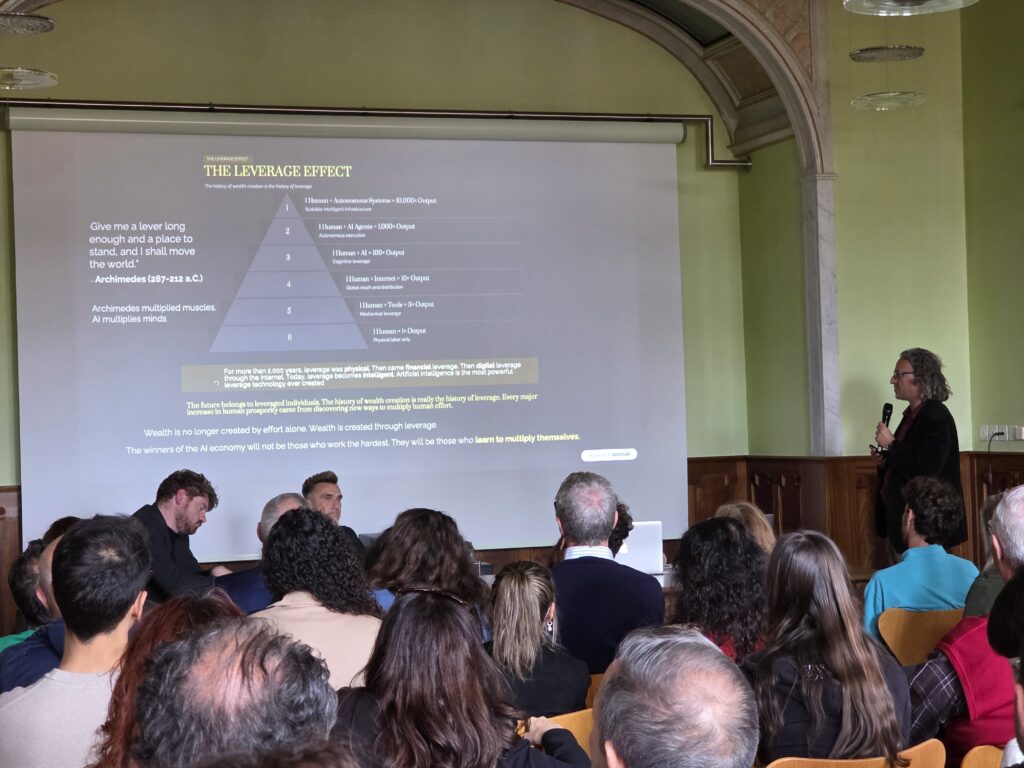
One of the central concepts discussed during the event concerns the issue of technological leverage.
Throughout history, economic growth has been driven by successive forms of leverage:
mechanical leverage has amplified physical strength;capital has amplified productive capacity;the internet has amplified the spread of information;artificial intelligence is now amplifying cognitive capacity.
For the first time, individuals, small businesses, local organizations, and territorial administrations can access skills and operational capabilities that were previously reserved exclusively for large organizations or central governments.
AI democratizes access to intelligence.
This distribution of cognitive capabilities could foster greater decentralization of decision-making and responsibility.
Paradoxically, a technology often perceived as a driver of power concentration could become one of the most powerful tools for power distribution ever developed.
The European challenges
This reflection is particularly relevant in the European context.
Europe today faces three structural challenges:
stagnating productivity;an aging population and labor shortages;and high levels of public debt.
Artificial intelligence could represent one of the few technologies capable of contributing simultaneously to the resolution of all three problems.
Higher productivity can support economic growth, improve the sustainability of public finances, and at least partially compensate for the declining available workforce.
The fundamental question is whether Europe will manage to become a leader in this transformation or whether it will limit itself to regulating technologies developed elsewhere.
Towards a “smarter federalism”
In public debate, we often speak about smart cities.
Perhaps it is time to also start speaking about smarter federalism.
A federalism enhanced by artificial intelligence could combine the best of two worlds: proximity to citizens and the flexibility of local governance, together with the analytical and organizational power of new technologies.
If the 20th century was the age of large centralized organizations, the 21st may become the age of intelligent networks, autonomous communities, and distributed institutions.
In this scenario, Switzerland could find itself in a privileged position.
Artificial intelligence will not only transform the way we work, produce, and innovate.
It could also redefine the way we govern our societies.
And if AI truly reduces the economies of scale that historically favored centralization, Swiss federalism could emerge as one of the institutional models best suited to the new era of artificial intelligence.
The challenge will not simply be to adopt AI.
It will be to build institutions capable of using it to strengthen freedom, responsibility, prosperity, and local autonomy.
For Switzerland, this could represent one of the greatest opportunities of the 21st century.

Art, artificial intelligence, and new creative languages
The conference was not limited to the economic, institutional, and technological aspects of artificial intelligence. A central role was also devoted to the cultural and artistic dimension of the ongoing transformation.
This perspective was represented by Stefano Cagol, an internationally renowned contemporary artist and participant in the 2026 Venice Biennale. In his intervention, Cagol explored the relationship between artificial intelligence, art, ecology, and the new creative languages emerging in contemporary culture.
The artistic reflection offered a complementary perspective to the economic and technological one, highlighting how AI is not only a productive tool, but also a force capable of redefining collective imagination, forms of expression, and the relationship between human beings, technology, and the environment.
At the end of the conference, Stefano Cagol presented the artistic performance Signal to the Future, a work combining visual effects, light, fire, and advanced technologies in a symbolic dialogue between present and future. The performance marked the concluding moment of an evening characterized by the intersection of science, innovation, art, and civic reflection.
Born in 1969, Stefano Cagol is one of the most internationally recognized Italian artists. Throughout his career, he has participated in the 61st, 59th, 55th, and 54th Venice Biennales; the 3rd and 2nd Something Else – Off Biennale in Cairo; Manifesta 11 in Zurich; the 14th Curitiba Biennial; the 1st Xinjiang Biennale; and the 1st Singapore Biennale, developing an artistic practice that investigates the relationships between energy, environment, technology, and contemporary society.
Video gentilmente offerto dal’artista Stefano Cagol