
Three states divided in half, but with the same dignity as the others
Although their federal representation has been halved, Obwalden, Nidwalden, Basel-Stadt and Appenzell Ausserrhoden and Appenzell Innerrhoden are no longer “half-cantons”…
The term is still widely used in common parlance, as befits a country steeped in historical vicissitudes, but the “half-cantons” in Switzerland no longer exist.
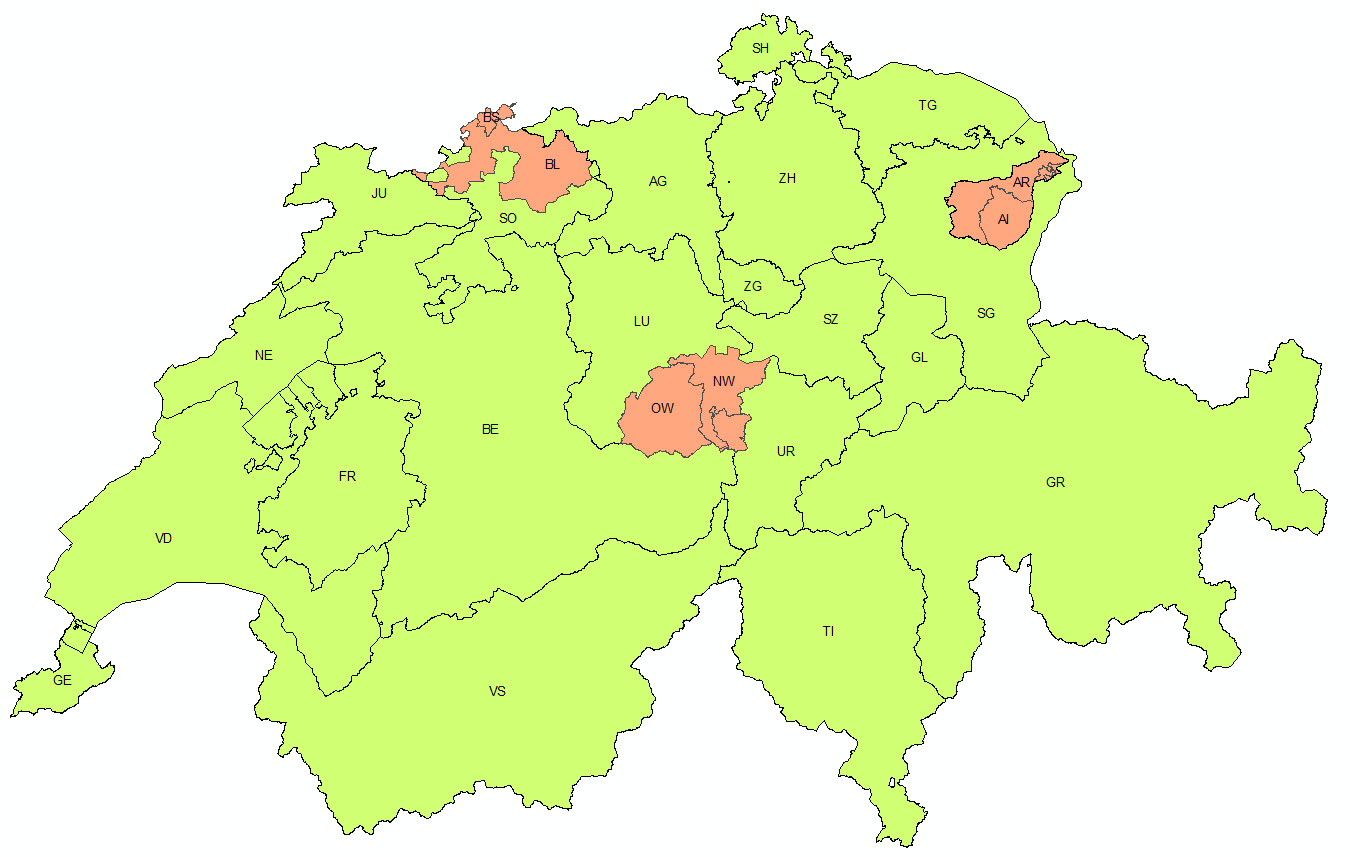
The “Halbkanton” historically indicated six cantons belonging to the Swiss Confederation which, despite having an autonomy equal to that of the other twenty states, have only half the weight in federal votes.
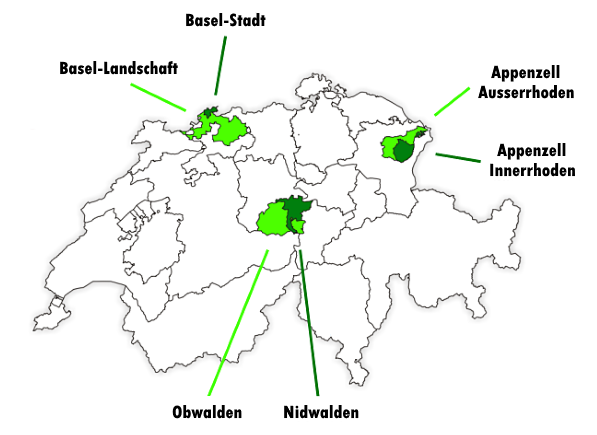
These are Obwalden, Nidwalden, Appenzell Ausserrhoden, Appenzell Innerrhoden, Basel-Stadt and Basel-Landschaft.
These cantons have only one vote in the Council of States instead of the usual two; in popular consultations, they have half a vote instead of one, in accordance with Article 142 of the Federal Constitution.
A revolution that began in 2000
Until the entry into force of the new fundamental charter on January 1, 2000, the term Semicanton was the official definition of these political units, on the assumption that there should be twenty-three Swiss cantons.
With the new Constitution, in the version approved on April 18, 1999 to come into force the following year, the term Halbkanton was replaced in Article 1 by Canton, without any change in the legal situation.
It is significant that the formation of Halbkanton took place before 1848, the year in which the new Federal Constitution, which followed and was a consequence of the Sonderbund War, considerably reduced cantonal sovereignty by introducing the Franc as the common currency.
Canton Jura, a French-speaking territory, broke away from the German-speaking Bern in 1979 to achieve full rights, but without creating a state that was half of another.
Each of the six Semicantons, as the name suggests, pairs with a second territorial public entity to form one of the following three historical, political, and geographic units:
Catholic and Protestant Appenzell
After the Lutheran Reformation, which particularly affected the German-speaking and German-cultured areas, in 1597 Appenzell split into two half-cantons with different religions, which are now fully-fledged cantons: Appenzell Ausserrhoden (Protestant), with its capital Herisau, and Appenzell Innerrhoden (Catholic), with Appenzell as the city of government and people’s assembly.


Basel aristocratic or rural
The canton of Basel was also divided, but for economic reasons and census: Basel-Land was separated because of the aristocratic predominance in urban areas. In 1833 the autonomy was recognized, but on an equal footing with Basel City: both were semi-cantons, as they are today.


Unterwalden separated by a forest
For topographical and orographical reasons, Unterwalden split off as early as 1150, i.e. before the creation of the Confederation. The two entities, which would later become Semicantons, were called Obwald and Nidwald.
From the German Wald, “forest”. and Unter, “at the address”, we can infer the reasons behind the schism, due to the fact that the two areas were separated by an impervious forest. Unterwalden, with its combined parts, later became one of the three Waldstätte, which together with the cantons of Uri and Schwyz formed the original core of Switzerland.