

Il bacio di Cremona
Quando il lavoro paziente e appassionato di un maestro incontra l’amore che sa ascoltare.
Nella piccola bottega di Antonio Stradivari, il tempo aveva l’odore della segatura e della resina.
Lui lavorava legni che tutti scartavano: assi di botti rotte, tavole di barche, pezzi che nessuno voleva più. E da quei silenzi tirava fuori violini che sapevano piangere e ridere.
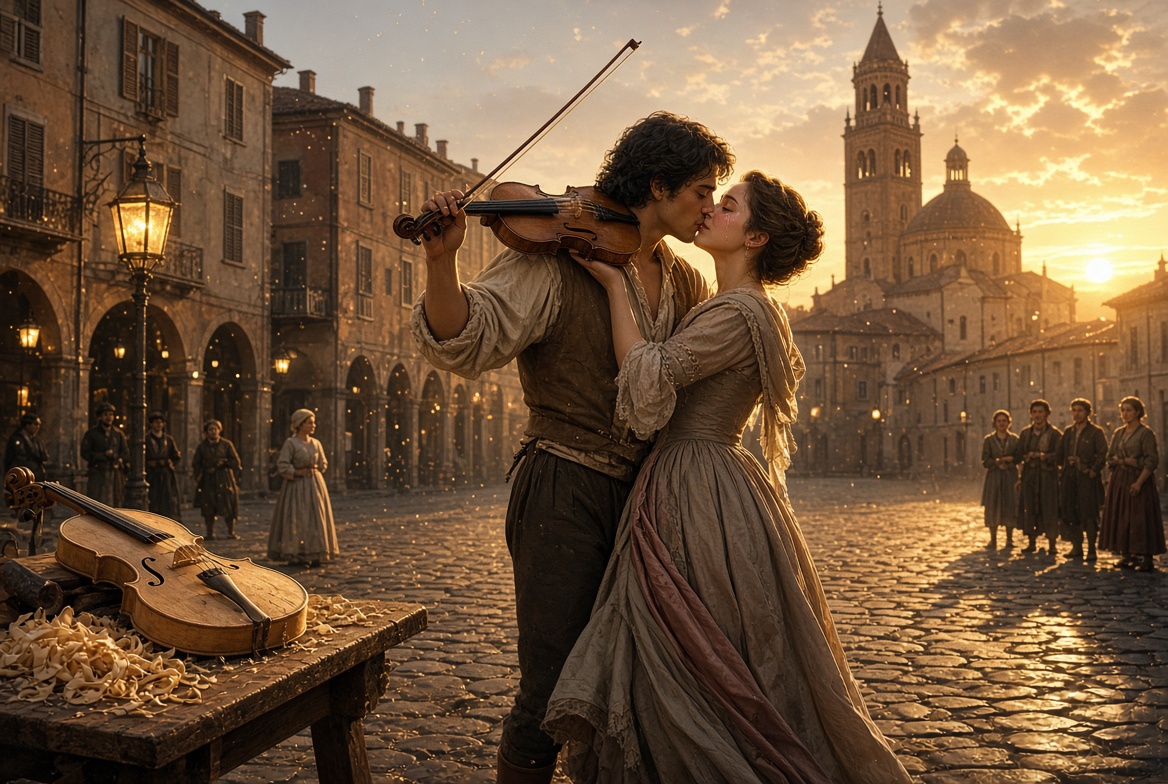
Ogni sera scendeva in piazza. Appoggiava il violino al mento e Cremona smetteva di parlare.
Tra la gente c’era sempre lei: Francesca Ferraboschi.
Non chiedeva nulla. Stava lì, con gli occhi chiusi, e lasciava che ogni nota le entrasse nel cuore.
Quella sera Antonio provò uno strumento nuovo, nato dal legno più imperfetto.
Le corde tremarono piano, poi cantarono.
Quando l’ultima nota morì, la piazza restò senza fiato.
La ragazza si avvicinò a lui, lo guardò con le lacrime agli occhi e gli disse: «Hai fatto piangere il mio cuore di felicità.»
Aveva ancora addosso il profumo della musica.
Non disse una parola.
Si alzò in punta di piedi verso di lui e lo baciò. Prese dalle sue labbra il suono che lui non era riuscito a dire.
Lui abbassò l’arco. Le mani, sporche di pece, le sfiorarono il viso.
Il 4 luglio 1667, nella chiesa di San Domenico, Antonio Stradivari e Francesca Ferraboschi si promisero tutto.
Lei fu la casa, la luce, la pazienza.
Lui le restituì quel bacio, in ogni violino che costruì.
Oggi i suoi strumenti valgono milioni.
Ma il più prezioso resta quello della prima sera: quello che nacque da un legno buttato via e da un bacio rubato alla musica.
La morale
Non è il legno a rendere immortale un violino. È il lavoro paziente, meticoloso e appassionato di chi lo costruisce, e l’amore con cui qualcuno lo suona.
Quando l’amore accorda il legno
Zaira Sellerio
The Kiss of Cremona
When the patient and passionate work of a master meets a love that knows how to listen.
In the small workshop of Antonio Stradivari, time smelled of sawdust and resin.
He worked with wood that everyone else discarded: planks from broken barrels, boards from boats, pieces that no one wanted anymore. And from those silences, he created violins that knew how to cry and laugh.
Every evening, he would go down to the square. He would rest the violin beneath his chin, and Cremona would fall silent.
Among the crowd, there was always her: Francesca Ferraboschi.
She asked for nothing. She simply stood there, eyes closed, letting every note enter her heart.
That evening, Antonio played a new instrument, born from the most imperfect piece of wood.
The strings trembled softly, then began to sing.
When the final note faded away, the square was left breathless.
The young woman walked toward him, looked at him with tears in her eyes, and said: “You have made my heart weep with happiness.”
She still carried the scent of music upon her.
She said nothing more.
She rose on tiptoe and kissed him. She took from his lips the sound he had been unable to put into words.
He lowered his bow. His hands, stained with rosin, gently touched her face.
On July 4, 1667, in the Church of San Domenico, Antonio Stradivari and Francesca Ferraboschi promised each other everything.
She became his home, his light, his patience.
And he returned that kiss in every violin he ever built.
Today, his instruments are worth millions.
But the most precious one remains the one from that first evening: the one born from a piece of discarded wood and a kiss stolen from music.
The Moral
It is not the wood that makes a violin immortal. It is the patient, meticulous, and passionate work of the person who builds it, and the love with which someone plays it.
When Love Tunes the Wood
Zaira Sellerio
Review
With The Kiss of Cremona, Zaira Sellerio portrays Antonio Stradivari from an intimate and poetic perspective, bringing to the forefront not only the great luthier, but also the man, his feelings, and the love that accompanied his life and his art.
Stradivari and Francesca Ferraboschi’s story is told through simple yet evocative images. Discarded wood becomes music, silence becomes emotion, and a meeting becomes the symbol of a love destined to endure through time.
Sellerio’s prose is spare and lyrical. The workshop, the square, and July 4, 1667, at the Church of San Domenico, become the setting for a love story shaped by presence, patience, and devotion.
“She became his home, his light, his patience. He returned that kiss to her in every violin he built.”
This is where the story finds its strength: in the connection between love and art, between a feeling lived and an artwork destined to become immortal.
“It is not the wood that makes a violin immortal. It is the patient, meticulous, and passionate work of the person who builds it, and the love with which someone plays it.”
The Kiss of Cremona is a delicate and evocative story, meant to be read slowly, allowing oneself to be carried away by the atmosphere of Cremona and by the music that seems to accompany every page.
A story for those who love Stradivari, music, Cremona, and still believe that love can leave a trace capable of enduring through time.
Zaira Sellerio’s Book „Il coraggio è femmina“ (Courage Is Female) is Available in Italian on Amazon!

Antonio Stradivari: The Story Beyond the Tale
Antonio Stradivari is considered the greatest luthier in history. Born in Cremona around 1644, he spent almost his entire life in the Lombard city, devoting himself to the making of violins, violas, cellos, and other string instruments.
His work reached its highest level between the late seventeenth century and the first decades of the eighteenth century. The instruments made during this period, often referred to as his Golden Period, are still regarded as absolute masterpieces of violin making.
Stradivari did not simply refine existing models: he studied the shape, proportions, thickness of the wood, and varnish with extraordinary attention, helping to establish acoustic and structural characteristics that would become a benchmark for luthiers of subsequent generations.
In 1667, he married Francesca Ferraboschi, with whom he had a large family. After Francesca’s death, Stradivari married again in 1699, to Antonia Maria Zambelli. He had numerous children in total, and some of them, particularly Francesco and Omobono, continued their father’s work in the family workshop.
Antonio Stradivari died in Cremona on December 18, 1737, at the age of approximately 93. He was buried in the Church of San Domenico, in the Villani family tomb, which he had acquired for his family.
The Church of San Domenico was demolished in the nineteenth century, and the original burial site was lost. The remains discovered during the demolition could no longer be individually identified with certainty.
Today, the name Stradivari is inseparably linked to Cremona. His instruments, still recognizable for their extraordinary craftsmanship and sound quality, are preserved in the world’s most important collections and entrusted to some of the greatest performers in classical music.
Among the musicians who have played Stradivari instruments are some of the most celebrated names in music history, from Niccolò Paganini to Yehudi Menuhin, David Oistrakh, Anne-Sophie Mutter, and Salvatore Accardo, as well as contemporary artists such as André Rieu.
Rieu, in particular, has owned and played several Stradivari instruments. Among them are a 1667 Stradivari, the first in his collection and one he used for many years during his tours, and a 1732 Stradivari, which remains a featured instrument in his concerts with the Johann Strauss Orchestra.
His legacy, however, is not merely that of a great craftsman. Stradivari still represents the meeting point of art, technique, patience, and the pursuit of perfection—values that transformed a workshop in Cremona into one of the most celebrated chapters in the history of music.