

Bilateral agreements and sovereignty: why Switzerland risks losing competitiveness
Between European cooperation and national autonomy: the limits of current agreements and the need for a more selective strategy
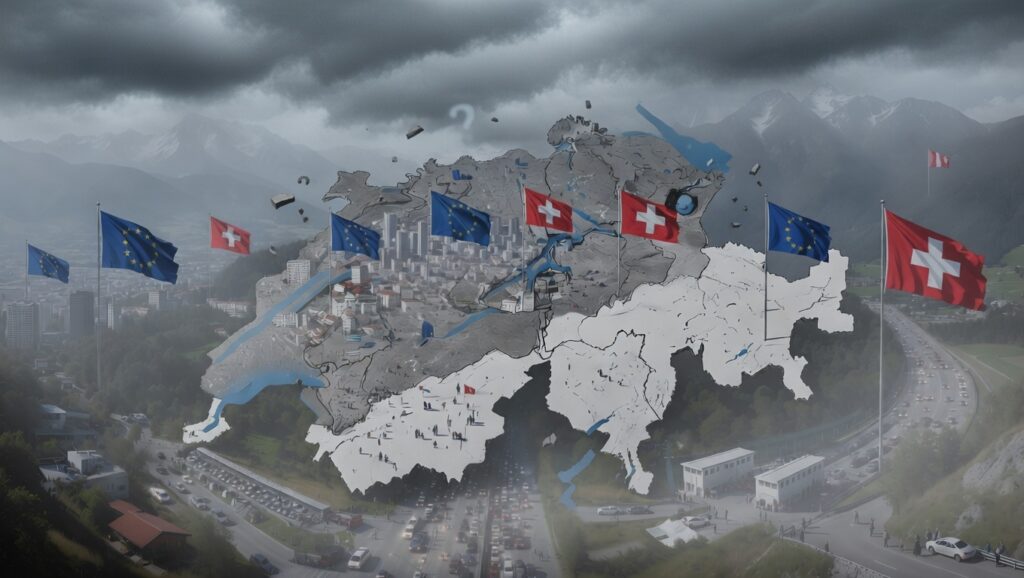
Switzerland has historically maintained its independence in Europe by avoiding membership in the European Union. Bilateral agreements have allowed the country to cooperate with the EU without fully joining, but today it is clear that this strategy is creating more problems than it solves.
The limits of bilateral agreements
The bilateral agreements between Switzerland and the European Union have enabled the country to maintain close relations without fully joining the EU. However, over the years these agreements have revealed several critical issues, with economic, social, and regulatory effects that now weigh on Switzerland’s competitiveness and autonomy. The main limitations include:
Free movement and the labor market
Switzerland is obliged to accept all European citizens. Many work in low-paying jobs, sometimes benefiting from social subsidies, and accept salaries below Swiss standards because their cost of living remains tied to their country of origin, to which they often intend to return in the medium to long term.
Spending of earnings abroad
A large portion of European workers’ income is spent outside Switzerland, on purchasing homes, consuming goods and services, and transferring savings to their country of origin, taking advantage of the lower cost of living. This “earn in Switzerland, spend elsewhere” model reduces the direct economic impact on domestic consumption, local investment, and commercial activity. Consequently, many restaurants, shops, and traditional businesses have closed in recent years, unable to bear high operating costs and increasing competition from online retailers or cross-border spending. In particular, sectors such as restaurants, bakeries, and specialized stores have experienced significant downsizing, highlighting how the decline in domestic consumption negatively affects the local economy.
Demographic and infrastructural pressures
The increase of commuters and European workers has led to rapid demographic growth in certain regions, creating urban congestion and overloading public transport, schools, and healthcare services. Although Switzerland still provides high-quality healthcare, superior to that in many EU countries, the growing demand for medical services — including visits, hospitalizations, and basic treatments — is putting existing facilities under pressure, with rising costs and longer waiting times. Moreover, many municipalities, especially small and medium-sized ones, struggle to maintain and develop leisure infrastructure that meets the needs of a growing population. Several local administrations report difficulties in providing adequate recreational services, as resources and investments are increasingly directed toward essential services and basic needs. Additionally, many foreign students often do not speak the local language, which places an extra burden on schools that must allocate resources to teach the language and ensure proper integration into the Swiss educational system.
Security and borders
Membership in Schengen has reduced border controls, complicating security management. In some areas, an increase in crime has been observed, mostly attributed to foreign nationals, affecting both local communities and the general sense of safety.
Cross-border workers and local wage compression
The presence of cross-border workers has compressed wages in border areas, reducing the bargaining power of Swiss workers. For cross-border employees, however, working in Switzerland is highly advantageous: wages are significantly higher than in their home countries, and the strong Swiss franc further increases their purchasing power. While this makes Swiss jobs attractive to foreigners, it creates real economic disadvantages for local workers, who face lower wages and greater difficulty negotiating better conditions.
Loss of regulatory autonomy
Bilateral agreements require Switzerland to adapt to European rules without the ability to negotiate them directly. In strategic sectors such as food safety, finance, and services, this has reduced the flexibility that previously favored the country’s competitiveness.
EES Launches across Schengen for Extra-EU travelers
Declining attractiveness
In recent years, there has also been a progressive decline in the attractiveness of the Swiss model. The end of banking secrecy, once a distinctive feature of the financial sector, and greater regulatory integration with Europe have reduced some of the country’s historical competitive advantages.
At the same time, membership in Schengen and alignment with international standards have made Switzerland more similar to other European countries, diminishing its uniqueness in the eyes of investors and highly skilled workers.
Increasingly, companies and professionals are looking at alternatives considered more dynamic or advantageous, such as Singapore for taxation and innovation, or emerging European countries like Ireland, which combines access to the EU market with competitive fiscal policies.
Ireland stands out among EU countries for its economic competitiveness, thanks to a corporate tax rate of 12.5% — the lowest among major EU hubs, even after the global minimum of 15% for multinationals — which attracts substantial foreign direct investment, especially from Big Tech and American pharmaceutical companies. This model, combined with full access to the single market, the use of English, a flexible common law system, and a skilled workforce, allowed Ireland to record GDP growth of +12.3% in 2025 (compared to the EU average of 1.5%), driven by exports and multinational profits.
The need for a different strategy
Agreements with the EU should not be abolished, but they must become targeted and selective. It is essential to focus on clear and advantageous agreements in strategic sectors such as innovation, finance, and technology to strengthen Switzerland’s competitiveness without overly restricting it. At the same time, the country must retain greater internal decision-making power, autonomously determining rules on wages, security, and demographic policies, avoiding external impositions that compress the labor market or overload public infrastructure. To protect the local labor market, hiring should always give priority to Swiss citizens before opening positions to European workers, as the country cannot accommodate all of Europe without economic and social consequences. It is also necessary to review policies regarding free movement and cross-border workers to safeguard the domestic labor market, prevent wage compression, and ensure that public infrastructure can adequately support the resident population. Finally, pensions in Switzerland are increasingly insufficient to guarantee a dignified life: many Swiss citizens, after a lifetime of work, are forced to move to countries with a lower cost of living or live in financial hardship to make ends meet. This is not only an economic problem but also a social injustice, as those who have contributed to the Swiss system for decades should not be forced to leave the country or drastically reduce their standard of living.
Conclusion
Switzerland has built its economic and social strength through independence and intelligent management of international relations. Bilateral agreements as they exist today are undermining these advantages, with increasing demographic, wage, and infrastructural pressures. The solution is not isolation, but targeted, strategic agreements that respect national sovereignty while maintaining competitiveness, security, and the well-being of citizens.