




Rumantsch: a language to discover
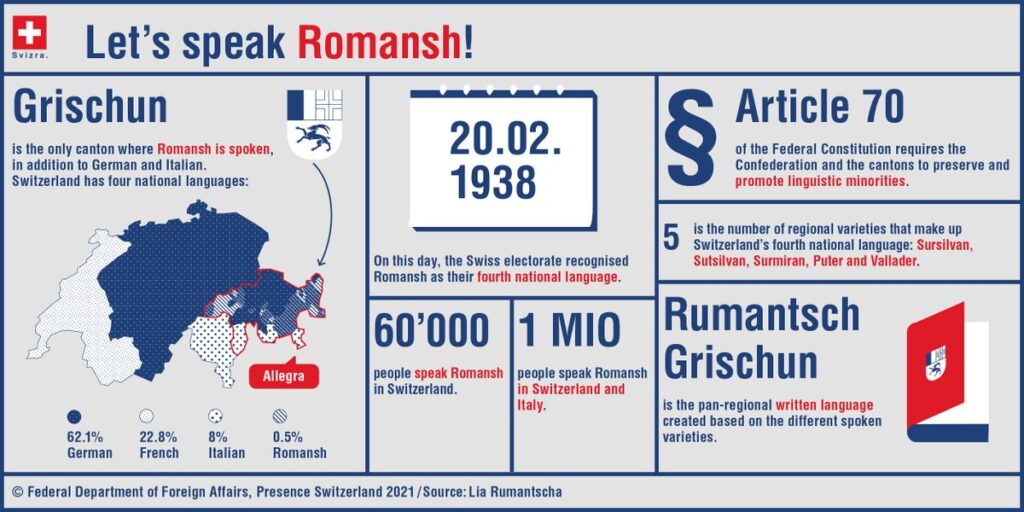
Romansh (rumantsch, romontsch, rumauntsch) is the fourth national language of Switzerland and is spoken in the trilingual Canton of Graubünden. It belongs to the Rhaeto-Romanic languages and has great affinities with Ladin and Friulian, which are spoken in northern Italy.
It was recognized as an official language by popular vote on February 20, 1938.
Since 1982 Graubünden Romansh has been the official administrative language of communication among the Romansh-speaking population. The cantonal constitution (also written in Romansh) sanctions the protection of “trilingualism” and the equalisation of the language with Italian and German, making Graubünden the only trilingual canton in Switzerland.
In the course of the last two centuries, this formerly widely spoken language (it probably reached as far as the Lake Constance area) has had an impressive decline, losing more and more ground to Swiss German. Today it is spoken by about 60,000 people and has its own public service channel, the “Radiotelevisiun Svizra Rumantscha”, whose programs are broadcast by Swiss German stations and are also accessible online.
“La Quotidiana” (local edition of the daily newspaper Südostschweiz) is the only newspaper in the Romansh language.
It is the subject of study in schools of all grades in those territories and many school lessons are taught in Romansh.
As the only language of the Swiss Confederation to be spoken only within its borders, it can be rightfully called the Swiss language.
Hurray for the first “Romansh Week” in Swiss history!
First works
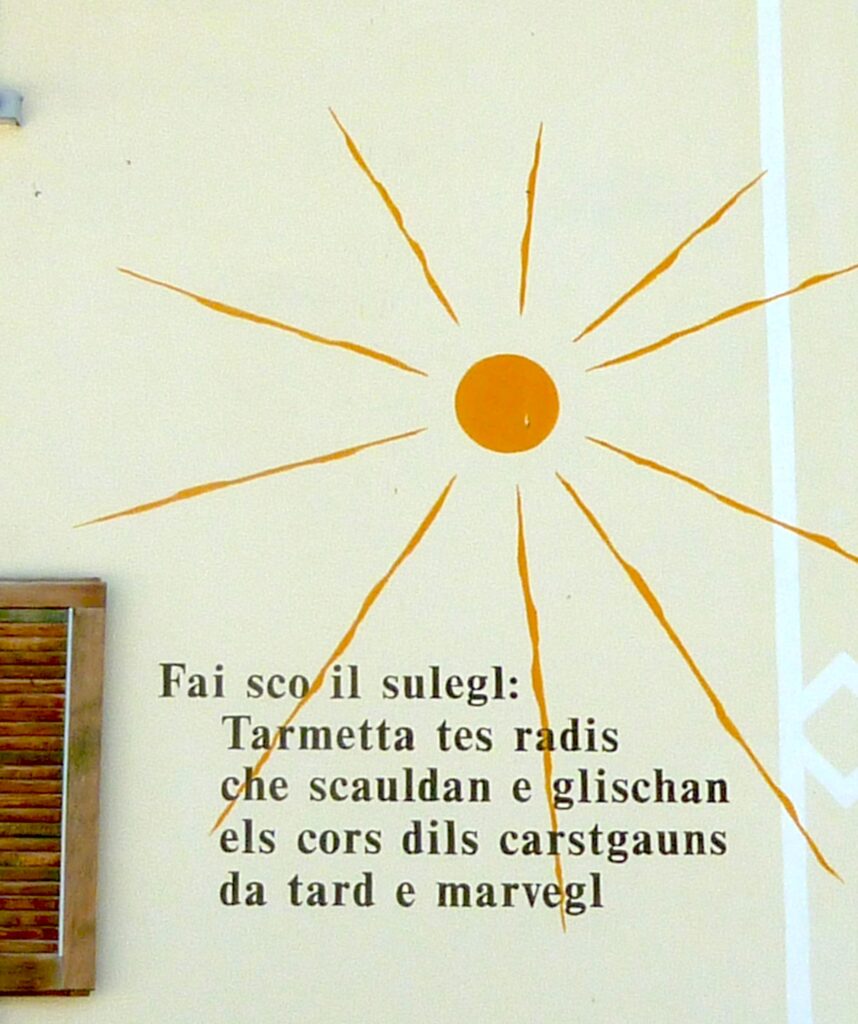
The “Chanzun da la guerra dalg Chiasté d’Müsch” by Gian Travers (1483-1563) from Engadin is the first literary work written in Romansh in 1527.
In 1560, with the Protestant Reformation, Jachiam Bifrun (1506-1572) translated the New Testament into Romansh and two years later, Durich Chiampell (1510-1582) published the Psalms .
The variants
There are 5 Romansh variants:
sursilvan (sursilvan)
sottosilvano (sutsilvan)
surmiran (surmiran)
upper Engadine (ladin putér)
lower Engadine (ladin vallader)
In 1982 Professor Heinrich Schmid (1921-1999) developed a standard language which was called “Rumantsch Grischun”.
Lia Rumantscha
The “Lia Rumantscha”, an association for the preservation and promotion of the Romansh language, was founded in 1919.
This organisation for the promotion of the Romansh language and culture is financed to a large extent by the Confederation and the Canton of Graubünden and offers courses in Romansh and promotes the use of this language.
Trilingual Online Vocabulary
MioPledari, a trilingual vocabulary (Italian, Romansh and German) is available online and allows you to translate not only into Rumantsch Grischun but also into the five main variants of the language.
Emna Rumantscha
“Emna Rumantscha” is the international week dedicated to the Romansh language, in addition to the “Days of Plurilingualism” and the activities organized on the occasion of the “Settimana della lingua italiana nel mondo” and the “Semaine de la francophonie”.
This annual event promotes the composite identity in Switzerland, plurality as an asset for the country.
Switzerland’s representations abroad also work to promote knowledge of the Romansh language and culture in their respective countries.
The promotion of minority languages is also part of the structured and ongoing political dialogue that the Head of the FDFA conducts with the cantons of Graubünden and Ticino.