




Italy, because differentiated autonomy “is” the Constitution
The initiatives of Emilia-Romagna, Lombardy and Veneto highlight great opportunities for institutions as a whole, as well as for the individual regions involved
The theme of the recognition of greater forms of autonomy to the Regions with ordinary statutes has imposed itself at the center of the debate following the initiatives undertaken by Lombardy, Veneto and Emilia-Romagna in 2017: the first two regions by virtue of the yes that came from the citizens in the seats of consultative referendums carried out on the territory, the third through an approval of the Legislative Assembly.
After signing three preliminary agreements with the Government in February 2018, at the request of the three Regions, the negotiations continued by expanding the framework of the matters to be transferred from that originally envisaged. In the meantime, other similar territorial public entities have embarked on the path for the request for special conditions of autonomy inaugurated historically by the administrators of Lombardy, Veneto and Emilia-Romagna.
During the hearing on the programmatic lines of October 17, 2019, the Minister for Regional Affairs highlighted the Government’s intention to restart from the work carried out so far and announced the presentation in Parliament of a legislative initiative aimed at defining a unitary regulatory framework in which interventions to implement the Constitution can be defined.
The “asymmetrical regionalism” at the heart of article 116
Article 116, third paragraph, of the Fundamental Charter of the Italian Republic, as it was updated to modern times by Parliament sixteen years ago, provides for the possibility of attributing particular forms and conditions of autonomy to the Regions with ordinary statute (so-called “differentiated regionalism” or “asymmetrical regionalism”, as it allows some realities to endow themselves with powers different from the others), without prejudice to the particular forms enjoyed by the Regions with special statute (Article 116, first paragraph).
Italy, because differentiated autonomy “is” the Constitution
The text of the fundamental passage evoked by Lombardy, Veneto and Emilia-Romagna for their petitions reads: “Further forms and particular conditions of autonomy, concerning the matters referred to in the third paragraph of Article 117 and the matters indicated by the second paragraph of the same article in letters l), limited to the organization of justice of the peace, n) and s), can be attributed to other regions, by State law, on the initiative of the region concerned, after consultation with local authorities, in accordance with the principles referred to in Article 119”.
A federalism now extended to many decisive matters
The scope of the matters in which these additional forms of autonomy may be recognized concern, in particular: all the matters that article 117, third paragraph, attributes to the concurrent legislative competence; a further limited number of matters reserved by the same article 117 (second paragraph) to the exclusive legislative competence of the State: organization of justice of the peace; general norms on education; protection of the environment, of the ecosystem and of the cultural heritage.
The attribution of these enhanced forms of autonomy must be established by means of a reinforced law, which, from a substantial point of view, is formulated on the basis of an agreement between the State and the Region concerned, having acquired the opinion of the local authorities concerned, in compliance with the principles set out in article 119 of the Constitution on the subject of financial autonomy, while, from a procedural point of view, it is approved by the Chamber of Deputies and the Senate of the Republic by an absolute majority of its members.
Since the introduction of these provisions in the Constitution, which took place with the reform of Title V provided for by Constitutional Law number 3 of October 18, 2001, the procedure provided for the attribution of differentiated autonomy has never been fully implemented.
From 2014 not only “special statute” Regions
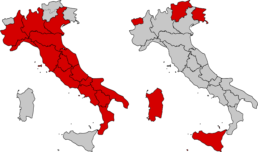
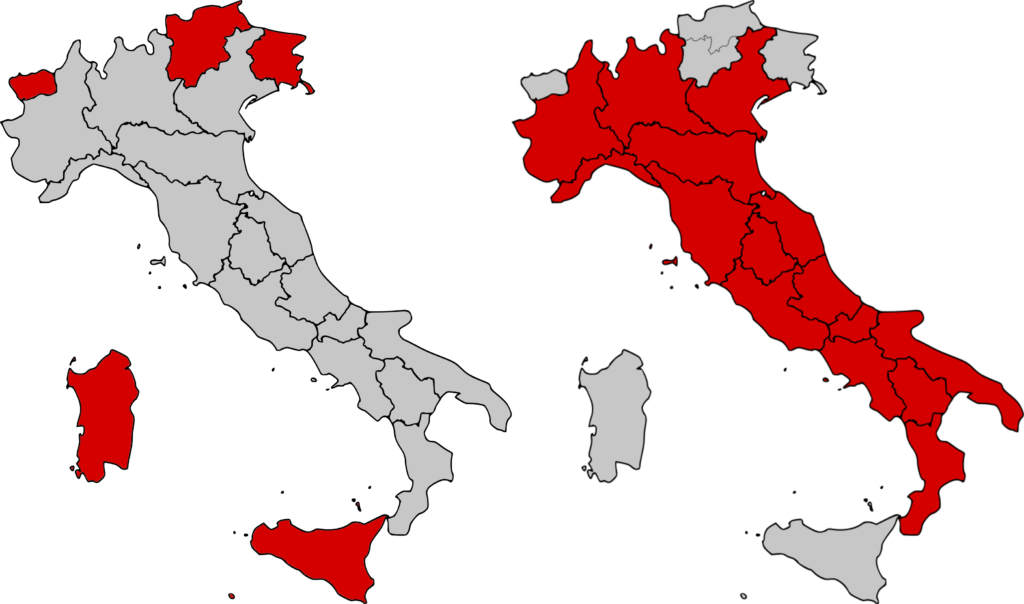
With the Stability Law for 2014, Parliament approved a number of provisions implementing article 116, paragraph 3, of the Constitution, relating to the initial phase of the procedure for the recognition of forms of greater autonomy to ordinary statute Regions, namely, all with the exception of Valle d’Aosta, Trentino-Alto Adige, Friuli-Venezia Giulia, Sicily and Sardinia.
In particular, the legislation has set a deadline of sixty days within which the Government is required to take action on the initiatives of the Regions presented to the President of the Council of Ministers and the Minister for Regional Affairs for the purpose of agreement (Article 1, paragraph 571, Law 147 of December 27, 2013). The mandatory deadline runs from the date of receipt of the initiatives and the obligation to activate translates into following up the impulse resulting from the regional initiative aimed at the agreement.
These provisions are therefore placed “upstream” of the procedure outlined by Article 116, third paragraph, of the Constitution, without prejudice, for this purpose, to the source provided therein, consisting of a reinforced law, the content of which is determined on the basis of an agreement between the Region and the State and the opinion of the local authorities concerned, approved by an absolute majority of both houses of Parliament.
On these issues, a fact-finding investigation was carried out during the year 2017 within the Bicameral Commission for Regional Issues, which ended with the definition of a conclusive document that traces the main elements.
More opportunities for the country from individual autonomies
In particular, the competent Commission highlighted how the autonomous path outlined by article 116, third paragraph, aims at enriching the contents and completing ordinary autonomy, within the framework of the design outlined by Title V of Part II of the Constitution and how the activation of special forms and conditions of autonomy presents significant opportunities for the institutions as a whole, as well as for the individual Region concerned.
The valorization of regional identities, vocations and potentialities determine, in fact, the insertion of elements of dynamism in the entire regional system and, in perspective, the possibility of favoring a virtuous competition among territories.
Preliminary agreement between the Government and the Emilia-Romagna Region (in Italian)
Preliminary agreement between the Government and the Lombardy Region (in Italian)
Preliminary agreement between the Government and the Veneto Region (in Italian)
The implementation of article 116, third paragraph, must not be understood in any way as detrimental to the unity of the Italian Republic and the principle of solidarity that distinguishes it. One of the most delicate points of the debate actually concerns the issue of financial resources that must accompany the process of strengthening regional autonomy.
In this regard, the need to respect the principle, developed by the jurisprudence of the Constitutional Court, also in the light of art. 81, of the necessary correlation between functions and resources has emerged as a central issue.
