

Norway says goodbye to King Harald V
Ascending the throne in 1991, he was deeply loved by the Norwegian people throughout his more than thirtyfive years of reign, both for his institutional role and for his personal qualities. His passing marks the end of an era for the Norwegian monarchy.
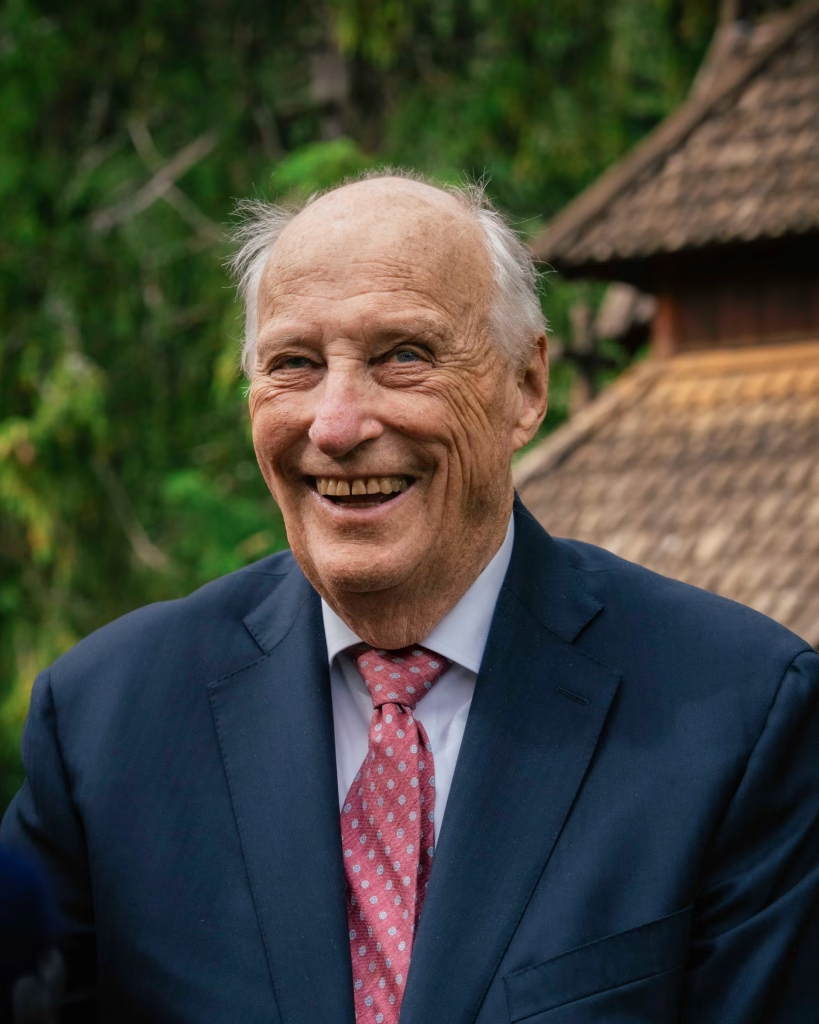
Norway woke up on Friday, August 28, to the news of the death of King Harald V. The King died at 6:35 a.m. at the age of 89 at Rikshospitalet, Norway’s national hospital in Oslo. Harald V was Europe’s oldest reigning monarch.
The monarch had been hospitalized on August 17 after a medical examination revealed a blood disorder. His condition subsequently deteriorated. The news sparked deep emotion across Norway.
With his death, an era that began in 1991 comes to an end, when Harald succeeded his father, King Olav V. He is succeeded by his eldest son, Crown Prince Haakon Magnus, who takes the regnal name Haakon VIII.
A prince born in Norway
Harald was born at Skaugum, near Akershus, on February 21, 1937. The only son of Olav V and Princess Märtha of Sweden, he was the first Norwegian king to be born in Norway in many centuries.
His childhood was marked by war. In 1940, following the German invasion of Norway, the royal family was forced to flee. Harald, his mother and his sisters spent part of the war years in Sweden and the United States, while King Haakon VII and Crown Prince Olav remained closely involved with the Norwegian government in exile.
The family returned to Norway at the end of the war. Harald thus grew up as a witness to a generation marked by occupation, exile and the reconstruction of the country.
From military training to Oxford
After graduating from Oslo Cathedral School, Harald attended the University of Oslo and the Norwegian Military Academy. In 1960, he moved to the United Kingdom to study at Balliol College, Oxford, where he focused on history, economics and politics.
The “Sailor King”
A passionate sportsman, Harald was nicknamed the “Sailor King” by the Canadian press because of his love of sailing.
He represented Norway at the Olympic Games in Tokyo in 1964, where he also served as the country’s flag bearer at the opening ceremony, as well as at Mexico City in 1968 and Munich in 1972. At the World Sailing Championships, he won gold in 1987, silver in 1982 and bronze in 1988.
His passion for sailing remained with him into old age. In 2022, at the age of 85, he still competed in a world championship event.
End of the era of Elizabeth II of the United Kingdom
The love of his life: Sonja
In 1959, Harald began a relationship with Sonja Haraldsen, a young woman from a commoner family with no noble background. Their relationship remained largely secret for years because of the dynastic conventions of the time.
Before Sonja, the royal family had also considered a possible marriage between Harald and Princess Sofia of Greece, who would later become Queen of Spain. But the young prince had already chosen Sonja and even threatened to give up his right to the throne rather than abandon the woman he loved.
After nine years of waiting and following the consent of his father, King Olav V, the couple married on August 29, 1968, at Oslo Cathedral.
They had two children: Märtha Louise, born in 1971, and Haakon Magnus, born in 1973.
Years later, Haakon followed a path similar to his father’s. He fell in love with Mette-Marit Tjessem Høiby, a commoner and a single mother. Their relationship initially sparked controversy and raised questions, but Harald V supported his son’s choice and gave his consent to the marriage, which took place on August 25, 2001.
A King close to his people
Following the death of Olav V on January 17, 1991, Harald ascended the throne as Harald V. After 648 years, Norway once again had a monarch born in the country.
For more than three decades, Harald represented the continuity of Norway’s constitutional monarchy. He presided over the Council of State, met with the prime minister and foreign minister, received foreign ambassadors and formally opened Parliament each year.
But his relationship with the Norwegian people went beyond protocol. His simplicity, love of sport and ability to connect with ordinary people helped make him a particularly popular figure.
A King with a primarily ceremonial role
Under the Constitution, Harald V formally held executive powers, but exercised them in accordance with parliamentary conventions established in Norway. His role was primarily institutional and representative: he formally appointed the prime minister, presided over the Council of State, opened Parliament each year and represented Norway on official visits abroad. A constitutional amendment in 2012 further reduced the monarchy’s formal ties to the Church of Norway.
Harald V and Switzerland
Harald V’s relationship with Switzerland also had an important institutional dimension. In April 2006, the King and Queen Sonja made a state visit to Switzerland, where they were welcomed in Bern by the entire Federal Council. Their trip also took them to eastern Switzerland, including St. Gallen and Appenzell, as well as Zurich.
The visit highlighted the many similarities between the two countries. Both members of EFTA and neither part of the European Union, Switzerland and Norway share a strong commitment to international cooperation, peace, environmental protection and sustainable development. Harald also emphasized the two countries’ cooperation in peace-building and the promotion of human rights.
The relationship remained close in subsequent years. In February 2024, Harald V received Swiss President Viola Amherd in Oslo during her official visit to Norway.
The final years and challenges for the royal family
In recent years, the Norwegian monarchy has faced several controversies involving members of the royal family, from the personal affairs surrounding Haakon and Mette-Marit to recent controversy over the princess’s contacts with Jeffrey Epstein and the legal proceedings involving Marius Borg Høiby, Mette-Marit’s son, who is not part of the direct line of succession.
Harald’s daughter, Princess Märtha Louise, has also faced criticism over her marriage to American Durek Verrett, who describes himself as a shaman, as well as for some of her activities related to spirituality and esotericism. In 2022, the princess stepped down from her official royal duties while retaining her title.
These controversies were compounded by the serious health problems affecting Mette-Marit, who has suffered from a progressive form of pulmonary fibrosis since 2018. Following a deterioration in her condition, the Crown Princess underwent a successful lung transplant in June 2026.
These events have placed the image of the monarchy under pressure, although support for the institution remains strong among Norwegians.
The succession: Haakon VIII takes the throne
With the death of Harald V, the crown automatically passes to his son, Haakon Magnus, who has ascended the throne as Haakon VIII. He will be joined by his wife, Mette-Marit.
Norway follows absolute primogeniture, under which succession passes to the firstborn child regardless of gender. Their eldest child, Princess Ingrid Alexandra, 22, therefore becomes the new Crown Princess and is destined to one day ascend the Norwegian throne.