

St. Lawrence night under a spectacular sky
August 12, 2026, between a solar eclipse and shooting stars
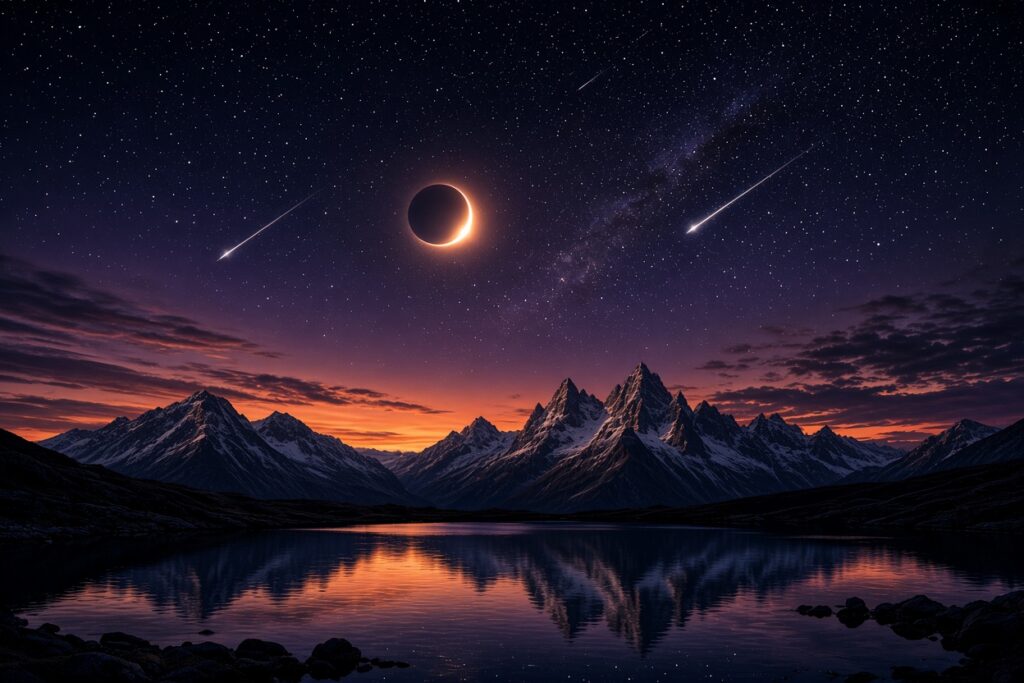
Every summer, around August 10, St. Lawrence Night brings with it one of the most beloved traditions: looking up at the sky, searching for a shooting star, and entrusting it with a wish.
In 2026, however, the sky will offer an even more remarkable spectacle. On August 12, a spectacular solar eclipse will also be visible from Switzerland, precisely during the days when the Perseids, one of the best-known meteor showers of the year, reach their peak activity.
It will therefore be a week in which the Sun, Moon, and stars seem to tell a common story, bringing together science, tradition, and imagination.
A near-total eclipse seen from Switzerland
The solar eclipse of August 12, 2026, will be total in some parts of the world, but from Switzerland it will be visible as a partial eclipse. The Moon will pass in front of the Sun, covering an exceptionally large portion of its disk.
The percentage of the Sun covered will vary depending on the location. In St. Gallen, it will be approximately 90.2%, in Zurich around 90.6%, while in the Geneva area it will reach approximately 92.8%. The maximum eclipse is expected between 8:17 and 8:20 p.m., depending on the location. In Zurich, for example, the eclipse will begin at 7:24 p.m., reach its maximum at 8:18 p.m., and end at around 8:42 p.m. In Geneva, it will begin at 7:26 p.m. and end shortly before 8:50 p.m.
In other words, more than nine-tenths of the Sun’s disk will be covered by the Moon. However, totality will not be reached: from Switzerland, a portion of the Sun will remain visible throughout the eclipse.
This distinction is particularly important from a scientific perspective. During a total solar eclipse, the Moon can completely cover the Sun’s photosphere for a few minutes, making it possible to observe the solar corona. During a partial eclipse, by contrast, part of the solar surface remains visible at all times, and the Sun’s brightness remains intense.
Why does a solar eclipse occur?
A solar eclipse occurs when the Sun, Moon, and Earth are almost perfectly aligned, with the Moon positioned between our planet and the Sun.
The Moon is approximately 400 times smaller than the Sun, but it is also about 400 times closer to Earth. This remarkable combination means that, when viewed from our planet, the Moon can appear almost exactly the same apparent size as the Sun.
It is this extraordinary geometric coincidence that makes total solar eclipses possible.
However, not every new moon produces an eclipse. The Moon’s orbit is tilted by approximately 5 degrees relative to the plane of Earth’s orbit around the Sun. An eclipse can occur only when the new moon passes sufficiently close to the points where the two orbital planes intersect.
AI Wealth Machine – strategies for the work and income of the future
How rare are solar eclipses?
Solar eclipses are not actually rare on a global scale: between two and five solar eclipses generally occur somewhere on Earth every year.
What is rare is being able to see one from the same location.
The Moon’s shadow that produces totality travels along a relatively narrow path across Earth’s surface. For this reason, many decades, or even centuries, can pass before a particular location experiences another total solar eclipse.
Even a very deep partial eclipse, such as the one that will be visible from Switzerland in 2026, is therefore a remarkable astronomical event.
And after the sun come the stars
The spectacle will not end with the eclipse.
During the same nights, the sky will be crossed by the Perseids, one of the most spectacular meteor showers of the year. The shower is active roughly from July 17 to August 24 and reaches its peak around August 12–13. Under ideal conditions, away from artificial lights, numerous meteors can be observed over the course of an hour.
The so-called “shooting stars” are not stars at all. They are tiny fragments of dust and debris left along the orbit of the 109P/Swift-Tuttle comet.
When these particles enter Earth’s atmosphere at extremely high speeds, around 60 kilometers per second, they compress and heat the surrounding air, producing the luminous trails we see across the sky.
The name Perseids comes from the constellation of Perseus, from which the meteors appear to originate when viewed from Earth. This apparent point of origin is known as the radiant.
A particularly favorable 2026 for observing the Perseids
There is another interesting astronomical coincidence: August 12, 2026, will be a new moon. This means that during the nights of peak Perseid activity, moonlight will not brighten the sky, making it easier to see even the fainter meteors, especially away from cities.
You do not necessarily need telescopes or sophisticated equipment to observe shooting stars. In fact, for meteor showers it is often best to watch the sky with the naked eye, lying comfortably and allowing your eyes to gradually adjust to the darkness.
The advice is to choose a location away from light pollution, avoid looking directly at sources of light, and be patient: meteors do not all appear in the same part of the sky and can streak across almost anywhere overhead.
Why do we make a wish upon a shooting star?
The tradition of making a wish when seeing a shooting star is much older than modern astronomy.
For centuries, the Perseids have been associated with the “tears of St. Lawrence”, according to a popular tradition linking the luminous streaks in the sky with the tears of the saint, who was martyred in the 3rd century.
This tradition gave rise to the belief that these “celestial tears” could bring good fortune or carry a wish.
But why a wish?
Perhaps because a shooting star lasts only a fraction of a second. It is a fleeting moment that immediately makes us think about what we truly wish for. The tradition therefore transforms an astronomical phenomenon into a small personal ritual.
And there is no need to wish for something extraordinary. A wish can be very simple: the health of the people we love, a new beginning, a journey, a project we hope to achieve, peace, serenity, or the courage to embrace change.
Perhaps the most fascinating part is that the wish remains secret. The shooting star becomes almost like a small promise we make to ourselves.
When a wish meets science
Of course, a meteor cannot literally make a wish come true. Science can explain precisely why that luminous trail appears in the sky.
Yet understanding the scientific explanation does not necessarily make the phenomenon any less magical.
On the contrary, knowing that we are watching a tiny fragment originating from a comet that has traveled through the Solar System and that, after crossing millions of kilometers of space, enters our atmosphere for just a few fleeting moments can make the experience even more extraordinary.
At that moment, a human wish and a cosmic event meet.
Between tradition and astronomy
St. Lawrence Night has its roots in Christian tradition and in the memory of the martyrdom of St. Lawrence, whose “tears” have been symbolically associated with shooting stars.
Modern astronomy offers a completely different explanation: those lights are meteors produced by tiny cometary particles entering Earth’s atmosphere.
But science and tradition do not necessarily have to stand in opposition.
In 2026, the sky will offer two remarkable reasons to look up: first, the Moon will obscure more than 90% of the Sun as seen from Switzerland; then, in the following nights, the Perseids will light up the sky with their luminous trails.
It is an occasion that brings together astronomy, culture, history, and imagination.
And perhaps the most beautiful wish to make upon a shooting star is simply to never lose the curiosity to look up.
One finalrecommendation: protect your eyes
During a solar eclipse, you should never look directly at the Sun without proper eye protection. Even when more than 90% of the solar disk is covered, the remaining portion emits enough radiation to cause severe and permanent damage to the retina.
To observe the eclipse, you should therefore use solar viewing glasses or filters specifically certified for direct solar observation. Ordinary sunglasses, even very dark ones, are not sufficient.
For shooting stars, on the other hand, all you need to do is wait for darkness, find a quiet location away from artificial lights, and… keep your wish ready.