

When the scale took control
Once upon a time there was an elderly man named Paolo, who loved eating more than anything else in the world. He wasn’t just a gourmet: he was truly greedy.
He was crazy about bread, even stale bread, as long as it was bread. He ate it in any way, in big or small pieces, without thinking too much. But his real weakness was Nutella: he didn’t even always spread it on bread… sometimes he ate it straight from the jar, by the spoonful, secretly, especially at night.
To avoid being caught, Paolo even went as far as hiding jars around the house. Once, while Margherita was tidying the wardrobe, she found several of them tucked between clothes, as if they were ordinary objects.
“What are these jars doing in here?” she snapped, furious.
He looked at her, pretending to be surprised.
“Me? I know nothing… I really don’t understand how they ended up there,” he replied, shrugging as if it were the strangest thing in the world.
He also loved sugary drinks, like peach iced tea, which he drank as if it were fresh water. And then strong, fatty flavours like bacon and lard, which for him were an impossible temptation to resist.
For Paolo, food wasn’t just food: it was pleasure, habit, comfort.
His wife Margherita often could no longer hold back. She didn’t scold him calmly: she shouted, exhausted after years of worry.
“Paolo! Look at yourself! Your belly has become enormous, you can’t even move properly anymore!”
And when she saw him take just a few steps and then stop out of breath, she would explode again:
“You walk two meters and you’re already out of breath!”
Her words were harsh, heavy, said with anger but also with fear.
But Paolo didn’t care.
Margherita’s shouting went in one ear and out the other. When she scolded him, he just shrugged.
“You always have something to complain about…” he muttered, already thinking about the next piece of bread or spoonful of Nutella.
Even when he stopped out of breath after a few steps, or when he felt his heart beating fast, he always found an excuse:
“I’m not twenty anymore, that’s all. It’s age… not weight. Let me enjoy life!”
But one day, his body said enough.
A sudden illness struck him out of nowhere.
He had just come out of the bathroom after his shower, like every morning, when he tried to speak to Margherita, but couldn’t. The words no longer came out properly: they were confused, slurred.
Even his body didn’t respond as it should: his arm felt heavy and wouldn’t move well.
It was a stroke, caused precisely by his constant excesses in eating.
The shock was enormous.
His wife Margherita was exhausted and no longer knew how to make him understand the seriousness of the situation.
He finally returned home after a month in hospital, and the family doctor, after severely scolding him for not following previous advice, was very clear:
“Either you completely change your lifestyle, or next time it could be fatal.”
Then he recommended an electronic scale.
The next day, Paolo bought it, though rather reluctantly. But that scale… was not normal.
As soon as he stepped on it, it said:
“Well done, piggy! Bread, Nutella, bacon and sweet tea… nice mix!”
Paolo was speechless:
“But… you talk?”
“And I observe too,” replied the scale. “And from today… I’m in charge.”
The first night it caught him in front of the fridge.
The scale had not stayed still in the bathroom, as one would expect from an ordinary object: it had moved. Silently, almost stealthily, it had crossed the house following Paolo step by step, even more attentive than his wife.
When he opened the fridge, he found it right there next to him.
“What do we have here? Bread with Nutella at two in the morning? After a stroke?”
“Just a little…”
“That ‘little’ sent you to hospital, remember?”
Paolo froze, spoon in mid-air.
“But… you walk?!”
“Of course I walk,” replied the scale. “And I will follow you everywhere. Better than anyone. Don’t think you can hide from me.”
Paolo muttered to himself, shaking his head:
“It’s all a conspiracy… now even the scale is haunting me…”
The next night:
“Bacon? Really? You want to invite cholesterol to another party?”
Frustrated, Paolo began to reflect. For the first time, he didn’t immediately respond with excuses or indifference. He stayed there in silence, looking at what he had in his hand, as if seeing it for the first time.
Then he began to stop. To think.
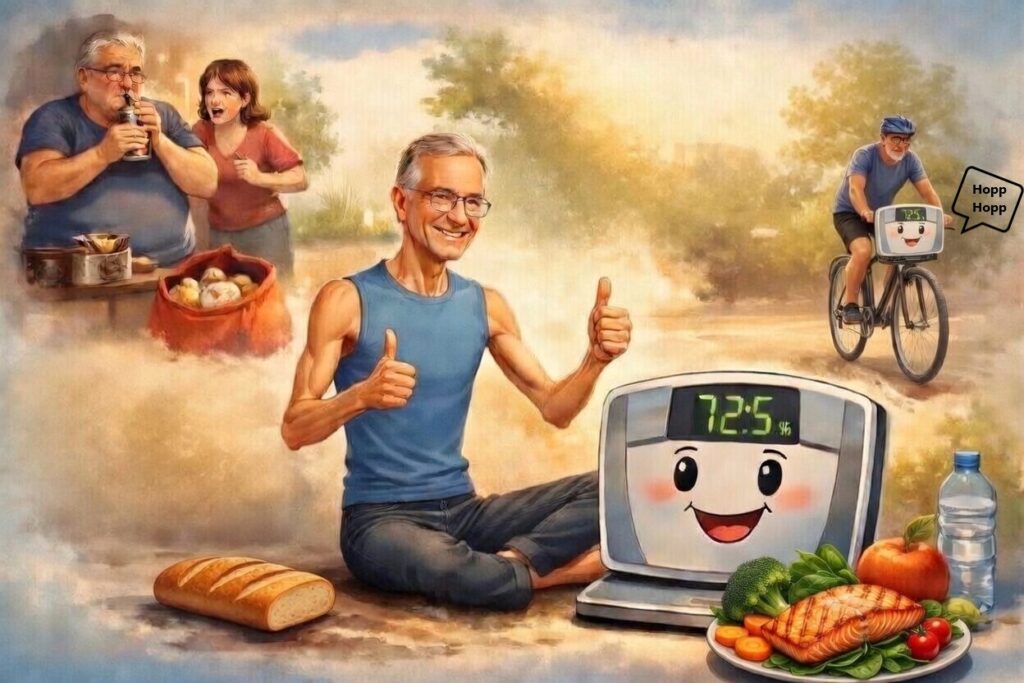
So the scale started controlling everything: bread was reduced, Nutella almost disappeared, sugary drinks were replaced with water.
And everything excessive was put into a bag.
“This is for those who truly need it,” said the scale.
Over time, Paolo understood that he wasn’t just giving things up: he was learning.
One day the bicycle arrived.
As always, the scale began talking to him during preparation and movement, but that time it didn’t just stay at home: it followed him everywhere, walking beside him and then even settling into the bike basket, as if it were the most normal thing in the world.
“A little ride around the block is useless, you need kilometers! Don’t try to cheat!”
Paolo pedaled, sweaty and focused, while in his head he could only hear that voice that wouldn’t let him give up. And sometimes, looking down, he would see it there in the basket, “watching” him even while riding.
After the bike ride, as he now did every day, he weighed himself.
Time passed. Day after day, through cycling, control and discipline, Paolo truly changed.
After a year of hard work, he was fit, lighter and more active.
“Well done!” said the scale. “You’ve lost 25 kilos! I’m proud of you.”
Paolo smiled, finally satisfied:
“I didn’t think I would ever make it…”
Over time, the bag of food intended for the poor kept filling up more and more. In the end, Paolo decided to take it to a center that provided food for people in need. There he met people with different stories, marked by life, and he stopped to listen to them.
In that moment, he understood something important: his had not just been a sacrifice, but a second chance.
Even his relationship with his wife Margherita changed deeply. The tensions of the past eased, and she ended up complaining much less. No longer needing to constantly watch him, nor fear that he would secretly binge at any time, she too found some peace.
Over time, Margherita decided to dedicate herself to others: she became a volunteer for the Red Cross, accompanying elderly and sick people to hospital appointments and helping those in difficulty.
From a life filled with worry, arguments and problems caused by excessive eating and bad habits, both of them ended up finding a new balance. Calmer, healthier and more useful to others as well. Over time, they also discovered the desire to devote part of their free time to helping those in need, giving even their souls a sense of lightness.
And every morning, Paolo continued his routine: movement, control and scale.
“I’m proud of you. Now yes… you know what it means to live.”
Zaira Sellerio
Review
“When the scale took control” is a small gem of contemporary storytelling—simple in form, yet profound in its message.
Paolo is an extraordinarily human character: indulgent, stubborn, and self-centred in his habits, but also fragile and capable of change. Through his story, the author does not simply describe a diet or a weight-loss journey, but a true physical and moral rebirth. What stands out most is how the “talking scale” becomes a clever and ironic metaphor for a conscience that finally awakens, after years of ignoring his wife Margherita’s worried outbursts.
The tone is light, almost fairy-tale-like, yet not sugar-coated. It makes you laugh (especially at the sharp, sarcastic dialogue of the scale), but it also invites reflection on the difficulty of change, the fear of illness, the loneliness of excess, and the beauty of sharing.
Particularly touching is the transformation that involves not only Paolo, but the entire family: Margherita regaining peace and discovering volunteering, and Paolo himself evolving from a selfish consumer into a giver. The story comes full circle with a beautiful lesson: reclaiming health is not just about losing weight, but about rediscovering meaning, lightness, and care for others.
A delicate story, full of humanity and hope, written with grace and a touch of Italian humour that makes it a joy to read.
Highly recommended for anyone who believes it is never too late to change… and for anyone, like Paolo, who might need a slightly more “talkative” scale to get started.
The book ‘Il coraggio è femmina’ by Zaira Sellerio is now available on Amazon in Italian!