





Switzerland and the “fantastic four” of direct democracy
Citizens’ initiatives for the total or partial revision of the constitution and abrogative or optional referendums embody the salt of a nation designed “for the citizens”
In Switzerland, democracy has both direct and representative forms. The fusion of the two systems is not unique to the Swiss Confederation, but
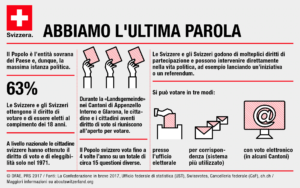
This is more pronounced than in other countries. Citizens can both propose legislation and reject legislation already passed by parliament, and they have the final say and the right to take the initiative.
As many as 103 federal votes between 1995 and 2005

Not only that: remaining in the field of qualitative-quantitative examples, one can venture a comparison with France: between January 1995 and June 2005, Swiss citizens voted 31 times on 103 federal issues, as well as many others on cantonal and communal issues; in the same period, passport holders of the République Française participated in only two referendums.
There are numerous methods for consulting those who enjoy the right to vote: at the federal level, depending on the issue. In addition to the right to vote and the right to stand for election, the Swiss have the possibility to assert their demands by means of four instruments that form the core of direct democracy: two types of popular initiative and as many forms of referendum.
In Switzerland, simple majorities are sufficient at the municipal and cantonal levels (50 percent plus one vote), but at the federal level, double majorities (of the people voting and of the cantons) are required for constitutional affairs.
In Switzerland, a citizen-proposed change to the federal constitution (i.e., popular initiative) cannot be approved at the federal level if a majority of the people approve but at least 14 cantons disapprove. In contrast, a majority of voters is sufficient for referendums or proposals in general terms (such as the principle of a general revision of the Constitution).
Two different forms of popular initiative

The popular initiative allows Swiss citizens to propose an amendment or extension of the Constitution. Its strength lies in stirring up or relaunching political debate on a given topic. In order for the popular initiative to succeed and be put to the vote, 100,000 signatures must be collected within 18 months. The authorities can submit a so-called “counter-proposal” to the initiative in the hope that the population and the cantons will prefer it to the proposal made by the committee:
(a) Popular initiative for the “total revision” of the Federal Constitution: 100,000 people entitled to vote may propose the total revision of the Constitution, and this proposal is obligatorily submitted to the People for approval;
b) Popular initiative for the “partial revision” of the elaborated Federal Constitution: 100,000 persons entitled to vote may request the partial revision of the Constitution by submitting an elaborated bill; this revision is submitted to the vote of the People and the Cantons, both of which reject or confirm it by a majority.
The referendum as an instrument of correction

Any constitutional change decided by parliament is subject to a mandatory referendum, as the people must be consulted in such cases. Switzerland’s membership of certain international organisations is also subject to a binding referendum:
(c) Mandatory referendum: amendments to the Constitution, international treaties, tax increases or decreases, the introduction of new taxes and federal laws declared to be “urgent” must be approved by vote of the people and the cantons;
d) Optional referendum: If 50,000 voters or eight cantons (federated republics of Switzerland) so request within 100 days of the official publication of the text of a particular provision, the following are subject to a popular vote: federal laws, federal laws declared to be “urgent” (valid for more than one year), federal decrees and international treaties.