
AI Wealth Machine – strategies for the work and income of the future
A comprehensive framework to leverage AI as a strategic tool, automate tasks, generate income, and design sustainable business systems.
The debate on artificial intelligence has become central in economic policy, the world of work, and governance models. On one hand, AI raises questions about employment, regulation, and the concentration of value; on the other hand, it opens up concrete opportunities for new forms of distributed economic autonomy, aligned with principles of flexibility, individual responsibility, and decentralization.
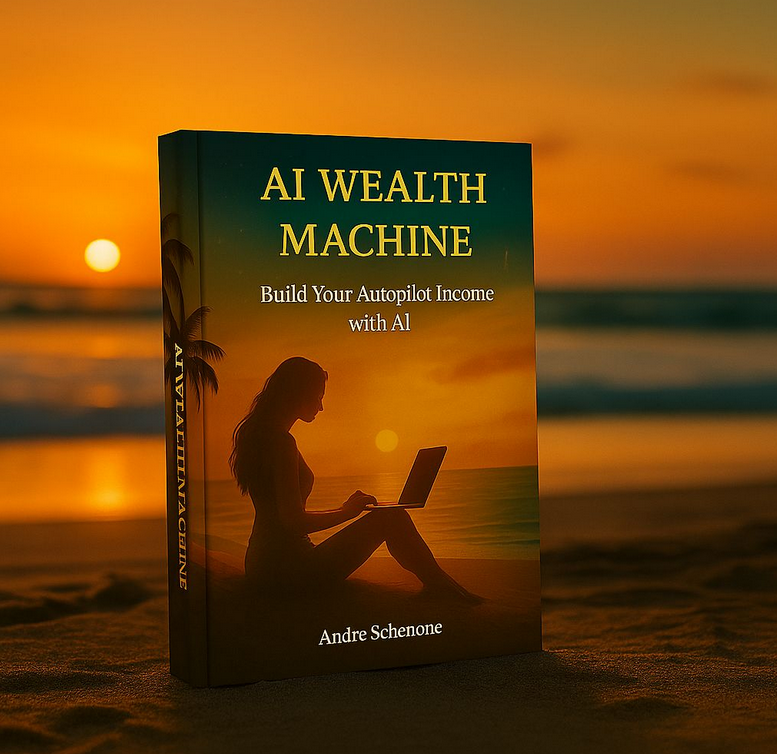
It is in this context that AI Wealth Machine, the book by Andre Schenone, comes into play. The book examines how artificial intelligence can be used not just as a technology, but as an enabling infrastructure for new, lightweight, and independent business models.
NRP and federalism: strengthening cohesion between cities and the countryside
From centralization to augmented micro-entrepreneurship
Historically, the creation of scalable economic value was the prerogative of large organizations, equipped with capital, personnel, and complex structures. AI changes this dynamic: today, automation tools, content generation, data analytics, and intelligent marketing allow even individuals or micro-teams to build sustainable digital businesses.
AI Wealth Machine explores this transition through the concept of Muse Business: a modular, digital, and automated business model designed to operate largely on autopilot, reducing dependence on the direct exchange of time for money.
The book proposes a practical framework that guides the reader in:
-
Identifying sustainable economic niches
-
Choosing business models compatible with automation
-
Strategically using AI tools
-
Building scalable yet lightweight systems
A Pragmatic approach, free from Hype
Unlike much of the popular AI literature, AI Wealth Machine avoids unrealistic promises or speculative narratives. Its approach is pragmatic and methodical, based on:
-
Academic research and economic analysis
-
International case studies
-
Direct experience in finance and technology sectors
The goal is not to “get rich quick,” but to rethink work and income generation in an increasingly automated economy, while valuing strategic skills, creativity, and human decision-making.
Implications for the future of work and individual autonomy
The book is aimed at professionals, entrepreneurs, freelancers, and decision-makers interested in understanding how AI can support more flexible and resilient work models. No technical background is required: the focus is on personal AI governance, not programming.
From the perspective of economic federalism, AI Wealth Machine suggests that artificial intelligence, when used correctly, can foster:
-
Decentralization of value creation
-
Lower barriers to entrepreneurship
-
Greater individual economic autonomy
-
New forms of balance btween work, income, and quality of life
About the Author: Andre Schenone
Andrea Schenone is a Swiss-Italian financial leader with over 25 years of experience in insurance, reinsurance, banking, technology companies, and international strategic consulting. He has held executive roles in major global groups and advised boards, CEOs, CFOs, and entrepreneurs in areas such as tax optimization, IFRS, group reporting, planning, and financial transformation.
He has gained significant professional experience in Switzerland, Liechtenstein, and Italy, collaborating with multinationals, innovative SMEs, and non-profit initiatives. He holds a degree in Economics from the University of Genoa, an Executive MBA from the University of Wales, is ACCA certified, and represents Switzerland in the Swiss Financial Analysts Association (SFAA) within EFFAS.
Beyond finance, Andre is active in civic and international networks: he is the founder of the Swiss Federalism Association, represents Switzerland in the Global Chamber of Business Leaders, and serves on the Scientific Committee of the Milton Friedman Institute.
In recent years, he has focused on the intersection of AI, finance, and digital entrepreneurship, developing non-linear income systems based on AI and promoting scalable, autonomous business models.
Conclusion
In a world where machines are performing an increasing share of operational work, the real challenge is not to compete with automation, but to design and govern it. AI Wealth Machine offers a structured, practical perspective on how artificial intelligence can become a tool for economic empowerment, rather than dependence.
Available on Amazon in English:
🔗https://www.amazon.com/dp/3907776003
Official landing page:
🔗 www.aiwealthmachine.ai