




The role of copper in Parkinson’s disease
Exposure to copper in the environment and alpha-synuclein protein in the human brain could play an important role in the pathogenesis of Parkinson’s disease: results of researchers’ studies could help develop new strategies for treating neurodegenerative diseases.

Long before the appearance of typical muscle tremor, the appearance of defective proteins in the brain could be an early sign of Parkinson’s disease although, the causes, are not yet fully known. Researchers at Empa and the University of Limerick in Ireland have now looked more closely at the abnormal form of these alpha-synucleins in the form of protein rings so that, they were also able to visualize on a nanoscale the link to environmental copper pollution. This sheds new light on the development of neurodegenerative disease and the role of biometals in the disease process. In addition, the results could provide opportunities to improve early diagnosis and treatment of the disease.
Raimondo Pische – a life set on work and basics extremely attentive to the toxicological aspect
Metal suspect
What is known about Parkinson’s disease is that neurons in the brain die, causing a deficiency of the neurotransmitter dopamine. In the more advanced stages of the disease, this leads to muscle tremors, muscle stiffness and even immobility. This slowly progressive disease is the second most common neurodegenerative disease in the world after Alzheimer’s disease. Environmental factors such as pesticides or metals could promote the onset of Parkinson’s. The team led by Empa researcher Peter Nirmalraj of the Transport at Nanoscale Interfaces laboratory is studying this hypothesis using chemical imaging and spectroscopy techniques and, in collaboration with Damien Thompson’s team at the University of Limerick, computer simulations. The researchers are targeting a protein involved in several molecular processes in the development of Parkinson’s disease: alpha-synuclein. In affected individuals, this endogenous protein aggregates and causes nerve cell death. Researchers suspect that copper in high concentrations interferes with these processes and accelerates the disease process.
The devil’s rings
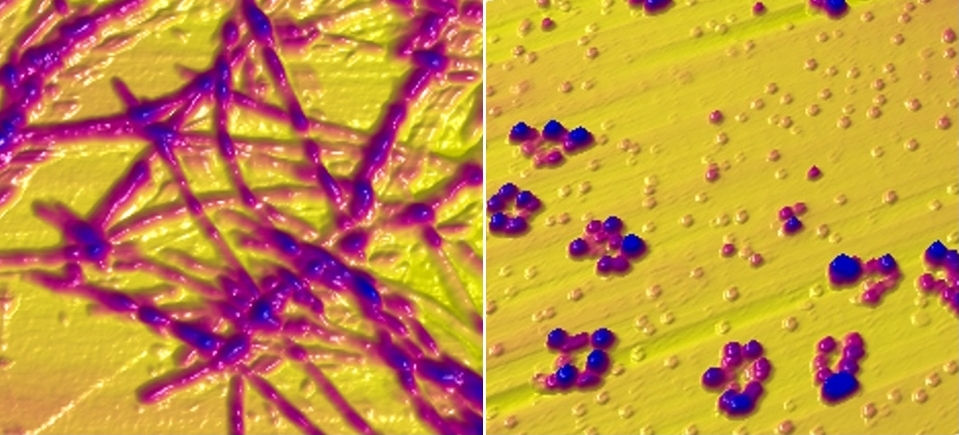
To visualize the aggregation of alpha-synuclein at the nanoscale, Empa researcher Silvia Campioni of the Cellulose & Wood Materials laboratory artificially produced the protein. Using atomic force microscopy, the researchers were then able to observe the protein, initially in solution, over a period of ten days as it formed individual insoluble filamentous structures before finally clustering into a dense network of fibrils. Based on the images, the transformation of the soluble protein into agglomerated fibrils about 1 micrometer in length, as it occurs during disease progression, can be observed with impressive accuracy in the laboratory. If the researchers then added copper ions to the protein solution, completely different structures appeared under the microscope: Ring-like protein structures of about 7 nanometers, so-called oligomers, appeared in the tube within a few hours. The existence of such ring oligomers and their cell-damaging effect are already known. Moreover, the longer fiber-like structures appeared earlier than in a copper-free solution. “On the one hand, high doses of copper seem to accelerate the aggregation process,” says Peter Nirmalraj. Moreover, however, this unusual ring-shaped protein structure develops relatively quickly under the influence of copper, which could mark the beginning of the pathological process or even trigger it. The researchers also analyzed the binding of copper ions to alpha-synuclein using computer simulations of molecular dynamics in small steps of 10 to 100 nanoseconds.
First experiment
Because oligomer rings are formed at the beginning of protein transformation, the rings could be used as targets for new forms of therapy, Nirmalraj hopes. In addition, the findings could contribute to the development of a test for Parkinson’s that can detect the disease at an early stage in body fluids, such as using samples of spinal fluid.
Parkinson’s disease in brief
Parkinson’s disease is a chronic progressive neurodegenerative disease (nerve cell death) that presents problems with body mobility, with slowed movement, muscle stiffness, and tremors.
This is one of the most common neurodegenerative diseases with about 10 million sufferers worldwide, most “Parkinsonians” are over 60 years old at the time of diagnosis, and men are more affected than women.
First described in 1817 by the English physician James Parkinson (hence the name of the disease), and although research has since then undertaken great efforts to elucidate its origin, the exact causes of Parkinson’s remain unknown. Current treatments can alleviate symptoms, but it is not possible to halt or stop the progression of the disease.
Source: EMPA