




Meloni’s rise signals a new era of Italian political stability
Giorgia Meloni is emerging as Europe’s unexpectedly resilient leader, reshaping Italy’s politics and influencing continental dynamics.
In a nutshell
-
-
-
-
-
-
-
-
-
- Meloni delivers stability through disciplined governance and coalition unity
- Pragmatic policy boosts her standing abroad, stabilizes domestic politics
- Fiscal prudence provides Meloni’s government with credibility
-
-
-
-
-
-
-
-
Political elites come and go. Sometimes leaders look as if they are on the brink of disappearing; in other cases, they stubbornly refuse to leave the scene. In today’s European Union, even leaders who are relative newcomers to government, like German Chancellor Friedrich Merz, do not look particularly strong. Institutions that once appeared almost almighty, such as the French presidency, seem frail. The major exception is the Italian prime minister, Giorgia Meloni.
With a solid majority at home and a rapidly growing reputation abroad, Prime Minister Meloni seems well positioned to be pivotal in the European order. It was a surprise to many when she won the elections in 2022; the international press decried a member of a post-fascist party becoming Italy’s prime minister. Before her rise, it seemed that no leader could be more appreciated abroad than her predecessor, Prime Minister Mario Draghi.
Yet Mr. Draghi headed an unstable, all-in coalition, in which the left and right − with the notable exception of Ms. Meloni’s party, the Fratelli d’Italia (Brothers of Italy), then in the opposition − had to engage in extensive deal-making. In contrast, Prime Minister Meloni is now at the helm of a political coalition that is far more coherent, with a composition like the one first assembled by Silvio Berlusconi some 30 years ago.
What is Meloni’s secret?
Ms. Meloni campaigned for more political stability, and claims the very duration of her government as her major success. Her ability to keep going reflects her political shrewdness.
“Italy” and “political stability” are words that are very rarely uttered together. Since 1948, the average duration of an Italian government has been 16 months. Prime Minister Meloni’s government is already the third longest-serving in the history of republican Italy. If there are no early elections (which could actually be in her interest, as her popularity remains very high), Prime Minister Meloni’s could be the first and only government in post-war Italian history to complete an entire parliamentary term without experiencing a political crisis, a reappointment or a new confidence vote. Even Prime Minister Berlusconi, in 2001-2006, technically headed two different cabinets.
Crafted in the aftermath of fascism, the Italian Constitution limits the powers of the prime minister. Politicians and jurists alike have long been examining this issue, and attempts to reform the constitution, aiming to recenter it around the position, have been on the agenda since the 1980s. They have routinely failed; each time, a veto coalition prevailed, often for petty political reasons.
Prime Minister Meloni’s could be the first and only government in post-war Italian history to complete an entire parliamentary term without experiencing a political crisis.
Prime Minister Meloni herself campaigned on a proposal for the popular election of the president of the republic (along the model of the Fifth Republic in France), which morphed into her more recent proposal for the direct election of the prime minister. As Italy is a parliamentary republic, the head of state is elected by parliament and the prime minister depends on the parliament’s confidence.
It is unclear if Prime Minister Meloni will successfully enact such a reform during this electoral term, which lasts until late 2027. A constitutional reform, if not approved by an absolute majority in parliament, needs to be confirmed via a public referendum. There is no quorum for such a referendum, meaning it does not take a certain percentage of the population to vote for the referendum to be valid. However many Italians show up at the ballot box, the result is valid. In this situation, committed opponents tend to prevail (not only in Italy – it is always easier to mobilize people against something than in favor of something else).
While such a change in the constitution would be a profound one, in terms of practical politics it may be a natural step, given the path Italy has followed for the last 30 years. This may explain why Prime Minister Meloni, though she has not yet accomplished this change, seems to embody its very essence: Italy has a strong prime minister, who is certainly in the driver’s seat of the government.
Reform of Italian citizenship ius sanguinis
Italian politics and Meloni comes of age
Since 1994, when Silvio Berlusconi entered the political ring, Italy’s politicians have been polarized and clustered around political leaders.
The end of the so-called “first republic” coincided with the demise of a purely proportional system of representation. Under the electoral law at the time, Italians cast preferences for members of parliament, but had no clue about the parliamentary alchemies that later produced a particular cabinet. Governments constantly reshuffled: The Christian Democrats stayed in power uninterrupted for 46 years. The Communist Party, as their major opponent, could not assemble a national government in the NATO country, and so the Christian Democrats subsumed different political sensibilities, including many left-leaning ones. The political focus was less about agreements among various parties than those within each of them.
That changed in 1994. Italians since then have voted for the specific coalitions that aim to govern (with the exception of the confused 2018-2022 term). They all run with a leader, claiming he or she will be the prime minister if they win. While he did not accomplish presidential reform, in parliamentary elections Mr. Berlusconi continued to associate his name with the presidency. In the graphic party icon on the ballot paper adjacent to his name, it featured the words “Berlusconi for President.” The same happened with Ms. Meloni.
Clearly, Italian politics results in polarization and the electorate has a taste for strongly visible political leaders.
Ms. Meloni has benefited from that. In 2022, when she won the election, she was the only major political leader who did not compromise with the previous Draghi caretaker government and with pandemic management. Though she was hardly new to the political scene (she entered politics in 1997 at the age of 20, and in 1998 was elected councilor of the province of Rome), she was overwhelmingly chosen in 2022 by the people as the new game in town.
Her coalition has a long history, but the post-fascist factions (the heirs of the Movimento Sociale Italiano, established in 1946 as a vessel for nostalgia of Italy’s fascist legacy) had been minority partners since 1994. Today, Prime Minister Meloni’s party is the biggest in parliament. Initially she took votes from Matteo Salvini’s Northern League (now simply “the League”), as she could claim to be more pristine in her anti-establishment spirit. But as she learned to talk like a moderate, her star kept rising.
Critics of Prime Minister Meloni accuse her of being closer to an old Christian Democrat politician than to her younger populist public image. There is a grain of truth in that. Ms. Meloni put her chips on three major reforms (justice, direct election of the prime minister and a higher degree of autonomy for regions), of which only one (justice) is moving forward.
Her government is hardly an activist one. Prime Minister Meloni focuses chiefly on foreign policy, and she understands that gaining global recognition is the way to pacify her coalition at home. Her junior partners are not happy that she has won over an impressive number of their former supporters. But they need to put on a proud face, as her leadership now is seen by friends and foes alike as belonging to a different, higher class.
In consolidating her position, a key strategy was pursuing fiscal discipline. Prime Minister Meloni’s finance and economy minister, Giancarlo Giorgetti, comes from the League but never shared the anti-austerity populism of that party’s leader, Mr. Salvini, nor of Ms. Meloni’s earlier days. Under Mr. Giorgetti’s watch, Italy has kept its public finances in order, committed to less spending in the future, recording a smaller budget deficit than what it promised. This may all seem anachronistic in a world in which everybody sings the praises of the entrepreneurial state, but Mr. Giorgetti knows the country’s weaknesses and understands that markets can easily turn their back on Italy.
Scenarios
Likely: Meloni emerges victorious from the next election
Fiscal prudence means Italy is no longer a ticking time-bomb for Europe. This is the framework in which Prime Minister Meloni could position herself. She speaks foreign languages well and has more experience in dealing with friendly parties abroad than most. But if anybody could accuse her of not doing her homework, her foreign policy reputation would quickly fade away.
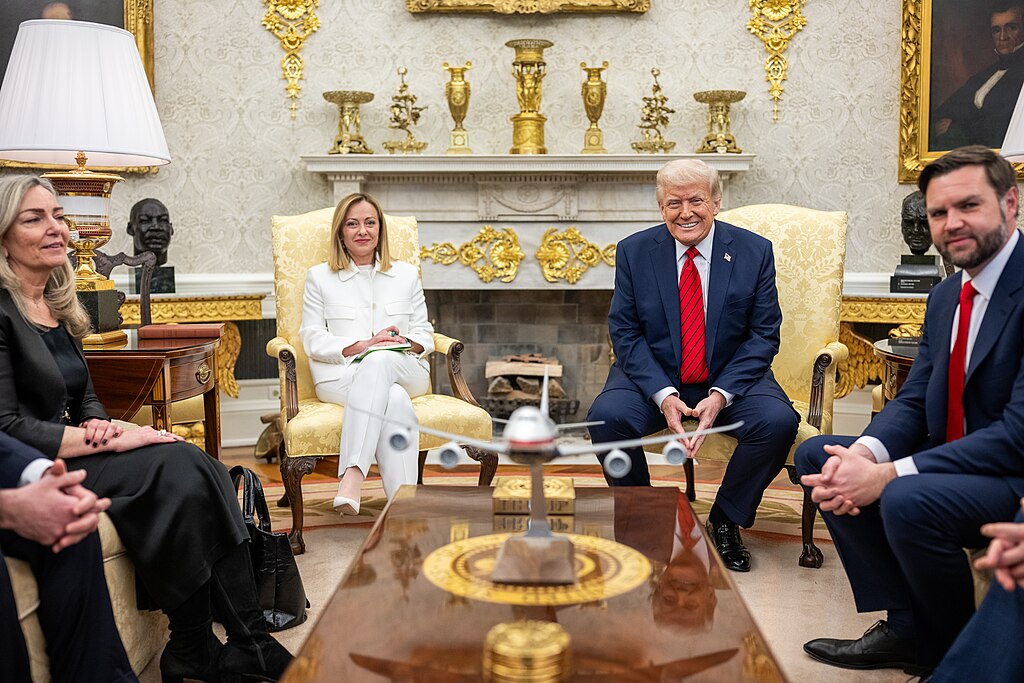
Prime Minister Meloni was quick in befriending former United States President Joe Biden and was also in establishing strong links with President Donald Trump. Mr. Salvini tried to fashion himself as the Italian Trumpian alter-ego, and ideologically certainly is, but this has had little effect. Prime Minister Meloni is the nation’s face, in Washington too.
However, the changing equilibrium in her coalition could unsettle the other members, which is a more substantial threat than the opposition. Since 1994, Italians have continually voted to remove whatever party is in power. They have a strong tendency to be disappointed by their current leaders and to choose another.
Still, the Italian opposition is hobbled. They will certainly try to build a diverse coalition unified simply by hostility toward Prime Minister Meloni. But for now, that may not be enough. The Democratic Party, once a center-left political force, moved sharply to the left. Its secretary, Elly Schlein, endorses all the catchwords of the contemporary political left. But demographically, Italy is among the less hospitable places on earth for woke theory and a political agenda centered around LGBTQ+ rights. These issues tend to be associated with the young, and Italy is not young.
Unlikely: The left-leaning opposition rallies voters via a referendum
The left can be revived by a referendum: Mobilizing naysayers is easier than building a positive agenda. An attempt in that direction was made in June, with a referendum on labor laws. It challenged a long series of reforms, implemented over several years by both the left and the right that produced the low unemployment rates Italy currently enjoys. The attempt failed.
Now the justice reform gives another opportunity to the opposition, and so would the direct election of the prime minister. But that is a long shot.
There is currently a debate about changing Italian electoral law. In particular, it seems that an agreement has been reached on the transition to a purely proportional system. Such a system could damage Ms. Meloni, reduce the appeal of her leadership and weaken the promise of the direct election of the prime minister. It is not clear why the prime minister should do her opponents the favor of supporting this change.
Prime Minister Meloni’s recipe, in short, is her ability to polarize the political scene and put herself at the center, which has been the Italian tradition since 1994. So as not to open too many fronts, she will likely continue three initiatives: prudently managed finances, which helped in building her foreign reputation; the strong emphasis on her persona; and keeping a rather limited focus on reforms.
Author: Alberto Mingardi – Director general of the Italian free market think tank Istituto Bruno Leoni and full professor of the history of political thought at IULM University in Milan and a Presidential Scholar in political theory at Chapman University.
Source: https://www.gisreportsonline.com/r/meloni-italian-political-stability/