

August 1st swiss celebrate homeland
On 1 August, the Swiss celebrate their homeland, commemorating the birth of the Confederation in 1291 with the Rütli Pact. With national pride, they combine history, traditions and a strong sense of community, accompanied by the national anthem, the Swiss Psalm. Although not the oldest nation in the world, Switzerland has enjoyed political continuity since 1291, making it one of the most stable nations through neutrality, independence and federalism. We discover the history, the celebrations, the most iconic festivities and the role of William Tell, Switzerland’s legendary figure!
History of the swiss national holiday
On August 1st, the Swiss commemorate the founding of the Swiss Confederation in 1291 with the Rütli Pact, an agreement among the cantons of Uri, Schwyz, and Unterwalden to ensure mutual defense and freedom. This pact marks the origin of modern Switzerland, defined by its commitment to neutrality, independence, and federalism. The date was officially designated as the national holiday in 1891 to celebrate the 600th anniversary of the Confederation.
Is Switzerland the oldest country in the world?
No, Switzerland is not the oldest nation. Ancient civilizations such as Egypt (circa 3100 BC), China (dynasties from circa 2070 BC), and India (Indus Valley civilization, circa 2500 BC) have far older histories. Greece (Mycenaean city-states, circa 1600 BC) and Japan (legendary monarchy from 660 BC) also have deeper historical roots.Nevertheless, the Swiss Confederation, established in 1291, stands out as one of the longest-lasting modern nations due to its remarkable political and institutional continuity, sustained by neutrality, independence, and federalism. This unique stability distinguishes Switzerland in the global context.
Swiss political continuity: neutrality, independence, and federalism
The Swiss Confederation stands out for its uninterrupted political continuity since 1291, free from revolutions or institutional upheavals, a unique achievement in Europe. The Confederation gradually expanded to include 26 cantons, always through mutual agreement and without wars, culminating in the Constitution of 1848, which established a modern federal state while preserving stability. This success rests on three pillars: neutrality, independence, and federalism.
Neutrality as a foundation of stability
Practiced informally since the 16th century and formalized at the Congress of Vienna in 1815, neutrality has shielded Switzerland from external conflicts, such as the Napoleonic Wars and World Wars, safeguarding its institutions. While France faced the Revolution of 1789 and Austria the dissolution of the Habsburg Empire in 1918, Switzerland remained a haven of peace. Neutrality fostered internal harmony among cantons with diverse languages (German, French, Italian, Romansh), preventing cultural conflicts. During the World Wars, Switzerland hosted organizations like the Red Cross and peace negotiations, reinforcing its global reputation.
Independence of the cantons
The confederal model, born with the Rütli Pact in 1291, ensures cantonal autonomy in matters of law, education, and culture. This has allowed diverse regions, such as the Italian-speaking Canton Ticino and German-speaking Zurich, to preserve their identities without tensions. The Constitution of 1848 balanced cantonal autonomy with national unity, avoiding forced centralization that elsewhere (e.g., France under Napoleon) sparked conflicts.
Democratic federalism
Swiss federalism integrates cantonal autonomy with a cohesive national system. Direct democracy, through referendums and popular initiatives, empowers citizens to shape laws, a system rooted in local assemblies (Landsgemeinde) and unique in Europe. This participatory approach has prevented revolutions, fostering gradual reforms and popular consensus. The Confederation’s expansion, from three original cantons to 26, occurred through peaceful agreements, without wars, reflecting dialogue and cooperation among communities.
Switzerland between cycling, walking and health
Last canton annexed: Jura
The last canton to join the Swiss Confederation was the Canton Jura, officially established on January 1, 1979. Its annexation occurred peacefully through a democratic process, without armed conflict. The Canton Jura emerged from a separation from the Canton Bern, driven by linguistic, cultural, and religious differences: Jura, predominantly French-speaking and Catholic, felt distinct from the largely German-speaking and Protestant Canton Bern.
The process began in the 1950s with separatist movements demanding greater autonomy. After years of negotiations and political tensions, the Confederation organized a series of referendums:
-
In 1974, residents of the French-speaking districts of Jura voted in favor of creating a new canton.
-
In 1975, a second referendum confirmed support from the Canton Bern and the Confederation.
-
Between 1976 and 1978, boundaries and separation terms were defined, with some districts choosing to remain in Canton Bern.
-
On September 24, 1978, a national referendum ratified Jura’s entry as the 26th canton, with the approval of the amended Swiss Constitution.
This process, rooted in referendums and dialogue, exemplifies Swiss democratic federalism, resolving cultural and political tensions without violence and maintaining national unity.
Last foreign territory annexed and still part of Switzerland: Canton Ticino
The last foreign territory annexed that remains part of Switzerland is the Canton Ticino, including the regions of Mendrisio and Lugano, officially incorporated into the Swiss Confederation in 1803. These territories, previously under Italian lordships and part of Swiss bailiwicks, were acquired during the Napoleonic era, when Switzerland was influenced by the Helvetic Republic (1798–1803).
The annexation occurred peacefully through negotiations and diplomatic agreements, without armed conflict. In 1803, the Congress of Vienna and Napoleon’s Act of Mediation reorganized the Swiss Confederation, recognizing Ticino as a full canton. The predominantly Italian-speaking population of Ticino chose to join Switzerland to ensure stability and protection, while preserving its cultural and linguistic identity. This process reflects Switzerland’s principle of cooperation and consensus, enabling the integration of culturally diverse regions without wars or coercion.
Between nature and silence the car-free villages to discover
Comparison with other European countries
Switzerland’s political continuity, which began in 1291, is unique in Europe, where many countries have experienced revolutions, civil wars or regime changes. A comparison with other European states highlights the uniqueness of the Swiss model:
- San Marino (301 AD): It is the oldest sovereign state in Europe, but its nature as a microstate, with a small population and territory, makes it less complex than Switzerland, which runs a multilingual and multicultural society (German, French, Italian, Romansh) within a federal system.
- France (since 486 AD): France has a long state history, but has suffered profound discontinuities, such as the French Revolution of 1789 and multiple regime changes (monarchies, republics, empires). Switzerland, on the other hand, has maintained uninterrupted political stability, thanks to its federalism and neutrality.
- United Kingdom (since 927 AD): The British monarchy is among the longest-lived, but events such as the English Civil War (1642-1651) and the execution of Charles I mark moments of rupture. Switzerland is distinguished by the absence of such major internal conflicts and its democratic confederal model.
- Portugal (1143): With some of the most stable borders in Europe, Portugal has experienced political discontinuities, such as the 1910 revolution that ended the monarchy. Switzerland, in contrast, avoided revolutions thanks to direct democracy and participatory federalism.
- Denmark (10th century): The Danish monarchy is among the oldest, but Switzerland differs in its confederal system, which integrates local autonomies without a central monarchical authority, guaranteeing stability through popular consensus.
- Austria: Austria suffered the dissolution of the Habsburg Empire in 1918 and the Anschluss in 1938, events that interrupted its political continuity. Switzerland, thanks to neutrality and federalism, preserved its independence and stability even during European crises.
National anthem
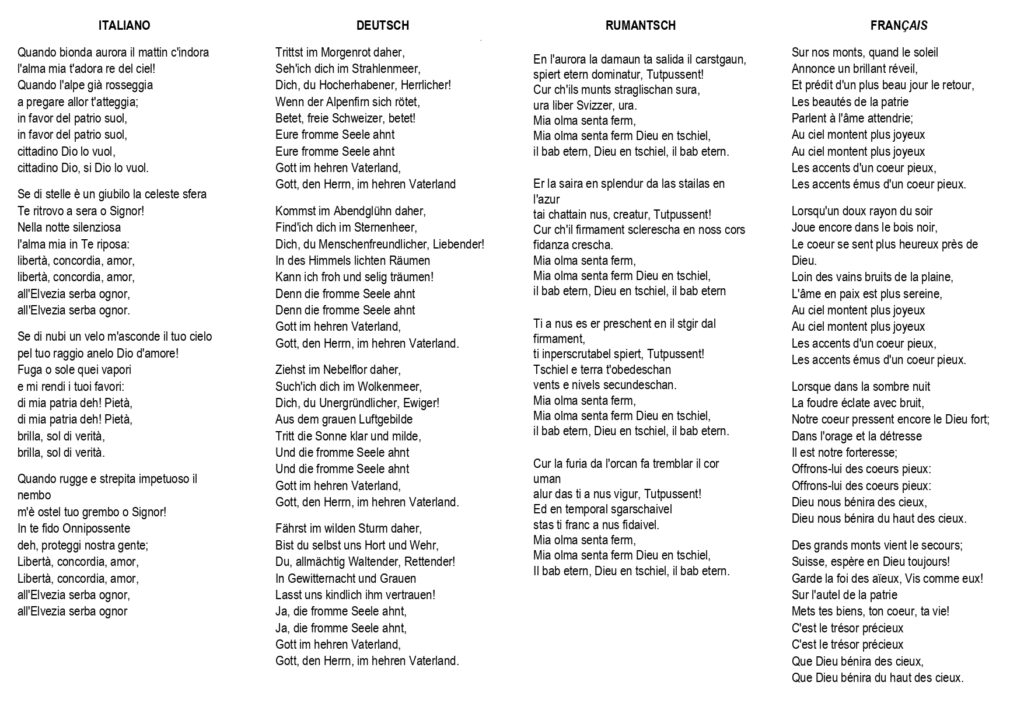
The Swiss Psalm, the national anthem since 1981, is central to the celebration. Composed in 1841 by Alberich Zwyssig with texts by Leonhard Widmer, it celebrates Swiss nature, freedom and faith. Sung in all four official languages, it unites the country during official and local ceremonies. It replaced Rufst du, mein Vaterland, too similar to God Save the Queen, with an authentic melody evoking mountains and lakes.
William Tell
William Tell is a legendary figure symbolising Swiss freedom, celebrated on 1 August. According to tradition, Tell was a crossbowman from Canton Uri who rebelled against Habsburg rule in the 13th century. The most famous story tells how he was forced by the Habsburg governor Gessler to hit an apple on his son’s head with a crossbow, succeeding with extraordinary precision. Tell then killed Gessler, triggering a revolt that contributed to the liberation of the Swiss cantons. Although his historical existence is debated, Tell embodies courage and resistance against oppression, core values of Swiss identity. During the national holiday, many localities stage plays on his story, and archery competitions pay homage to his legend.
Types of celebrations
1 August celebrations vary from region to region, but combine common elements that reflect Swiss identity. Here are the main types of celebrations:
Bonfires and Fireworks
- Bonfires are a central tradition, a symbol of unity and freedom. Large bonfires are lit on hillsides or in scenic locations, often accompanied by spectacular fireworks.
- In many locations, the bonfire is preceded by a public speech celebrating Swiss history and national values, often with the performance of the Swiss Psalm.
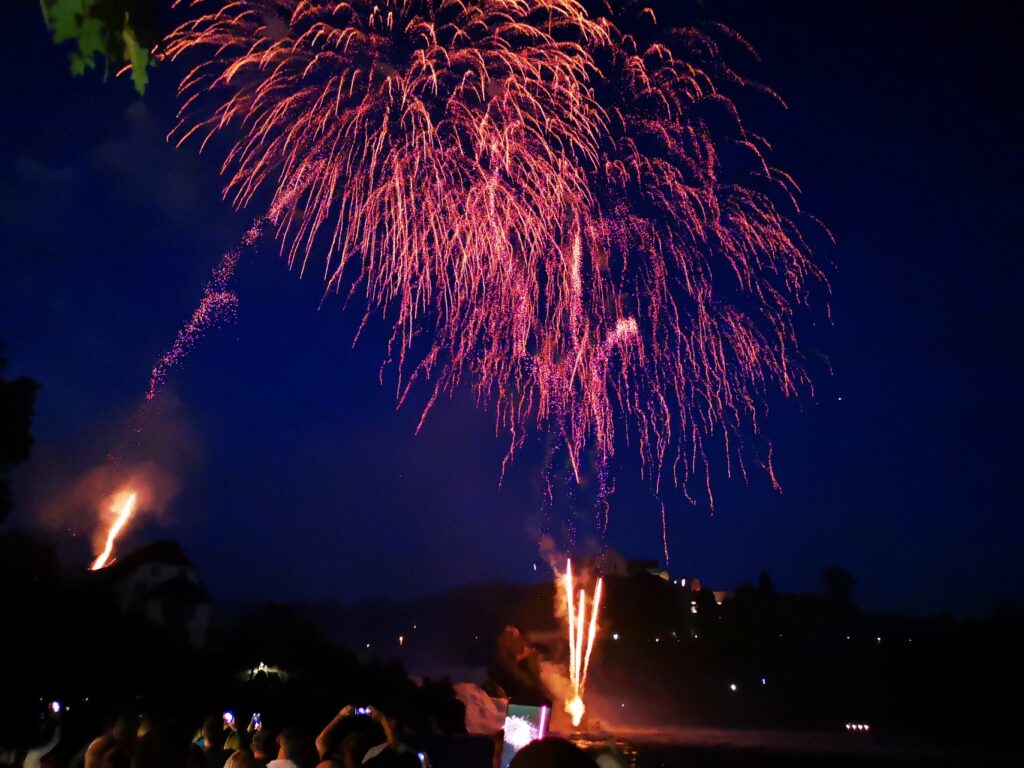
- Fireworks, organised by municipalities or associations, light up the night sky, especially in larger cities.
Official events and speeches
- Municipalities organise official ceremonies, often with speeches by the mayor or local authorities, accompanied by the Swiss Psalm. At the national level, the President of the Confederation gives a speech broadcast live, often from the Rütli lawn, followed by the national anthem.
- These events emphasise the themes of unity, democracy and peace.
Folk Festivals and Local Traditions
- Parades: Many towns and villages hold parades with Swiss flags, music groups and traditional costumes, often accompanied by the singing of the national anthem.
- Music and Dances: Local bands, choirs and yodelling groups perform traditional Swiss music, with the Swiss Psalm often included in musical programmes.
- Food and Markets: Festivals include food stands with specialities such as raclette, fondue, grilled sausages (e.g. cervelat), rösti and typical sweets such as Zuger Kirschtorte.
- Street lamps and flags: Children participate with street lamps decorated with the Swiss cross, and houses are decorated with national and cantonal flags.
Family Activities
- Games, children’s workshops and recreational activities are common in parks and squares.
- In some locations, archery competitions or sporting events are organised in homage to the legend of William Tell, a symbolic figure of Swiss freedom.
The most famous festivities
Some Swiss localities are renowned for their spectacular celebrations, attracting both residents and tourists:
Rütli Meadow (Canton Uri)
- The symbolic location of the Confederation hosts an official ceremony with the President’s speech, broadcast live nationwide, and the performance of the Swiss Psalm.
- The view of Lake Lucerne and the bonfires on the surrounding hillsides create an impressive atmosphere.
- Limited access, but the event can be followed on TV or radio.
Rhine Falls (Schaffhausen)
- Europe’s largest waterfalls are the stage for one of Switzerland’s most impressive firework displays.
- Thousands of visitors gather to admire the illuminated falls and the synchronised fireworks with music, often accompanied by the Swiss Psalm.
Zurich
- The city organises events along Lake Zurich, with fireworks, concerts and food stands. The Swiss Psalm is performed during official ceremonies.
- The Sechseläutenplatz and the lakeside promenade are the focal points of the celebrations, with parties lasting well into the night.
Berne
- The capital hosts official celebrations in front of the Federal Palace, with speeches, music (including the Swiss Psalm) and bonfires.
- The fireworks on the Gurten, Bern’s panoramic hill, are a must-see attraction.
Lugano (Ticino)
- In Canton Ticino, celebrations combine Swiss flair with Italian influences. Concerts, markets and fireworks are held on Lugano’s lakefront, with the Swiss Psalm sung in Italian to reflect the local community.
- Local specialities such as polenta and luganighe enrich the experience.
Basel
- Basel celebrates with a combination of bonfires, fireworks on the Rhine and neighbourhood festivals, with the national anthem performed during ceremonies.
- The city also offers cultural events, such as concerts of classical or modern music.
Unique traditions and curiosities
- William Tell: In many celebrations, reference is made to the legend of William Tell, a symbol of freedom and resistance. Some villages stage theatrical representations of his story.
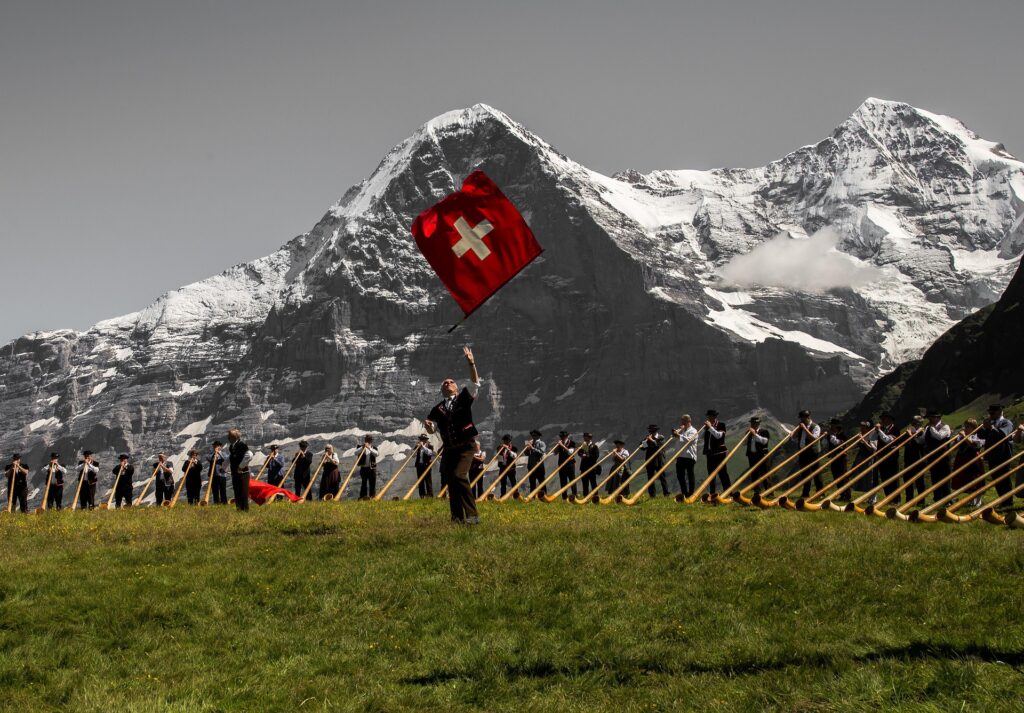
- Alpine bells and horns: In some Alpine regions, bells and horns are played to accompany the celebrations, creating a characteristic sound that resonates in the valleys.
- Multilingualism: Speeches, songs and the Swiss Psalm reflect the four official languages, with events celebrating Swiss cultural diversity.
- Sustainability: In recent years, some cities have introduced environmentally friendly fireworks to reduce pollution.
Conclusion
On 1 August, the Swiss celebrate their homeland with a festival celebrating unity and national pride. The extraordinary political stability, which began with the Pact of 1291, is the result of neutrality, independence and federalism, which distinguish Switzerland from nations such as France, the United Kingdom, Portugal or Austria. Neutrality protected the country from external conflicts, the independence of the cantons ensured internal harmony, and federalism, with direct democracy, made the citizens protagonists of governance. The Swiss Psalm and the legend of William Tell reinforce the national identity, while bonfires and fireworks light up the Alps and cities. Whether you are in Zurich, Lugano or an Alpine village, 1 August is the perfect opportunity to immerse yourself in Swiss culture!