

Switzerland: growing better, not just growing more
Productivity, innovation, and quality of life as an alternative to uncontrolled growth
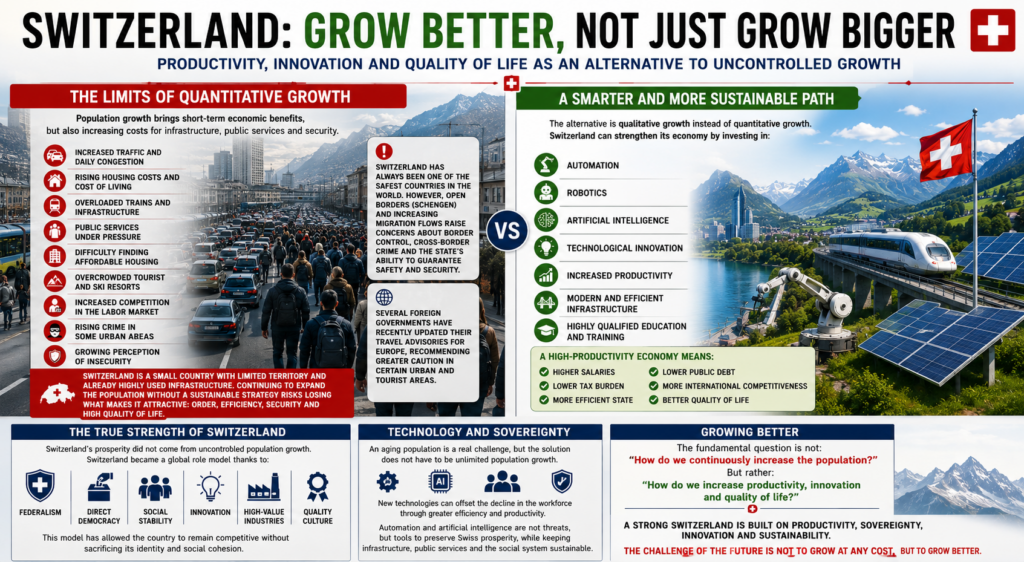
In recent years, Switzerland has found itself facing a crucial choice: continue to rely on constant demographic growth or focus on qualitative growth based on productivity, innovation, and quality of life. The debate on mass immigration is not only about numbers, but about the model of society we want to build for the future.
The limits of quantitative growth
Population growth certainly brings short-term economic benefits, but it also comes with increasingly visible costs. In many Swiss regions, citizens perceive growing pressure on infrastructure, public services, and security.
Among the most frequently cited problems are:
- increasing traffic and daily congestion;
- rising rents and cost of living;
- overloaded trains and infrastructure;
- pressure on social services;
- difficulty finding affordable housing;
- overcrowding in tourist and ski destinations;
- growing competition in the labor market in certain sectors;
- increase in crime;
- growing perception of insecurity among citizens.
For many Swiss people, the most worrying change is not only economic, but the feeling that the country is gradually losing the security, stability, and calm that for decades have been one of the Confederation’s main strengths.
Switzerland has always been considered one of the safest countries in the world. However, the opening of borders within the Schengen area and the increase in migratory flows have fueled an increasingly heated debate about territorial control, cross-border crime, and the state’s ability to guarantee order and security in the long term.
Several foreign governments have recently updated their travel recommendations for citizens heading to Europe, advising greater caution than in the past in certain urban and tourist areas. This reflects an international perception that the European security context has changed in recent years.
Switzerland is a small country, with limited territory and already heavily used infrastructure.
Continuing to expand the population without a sustainable strategy risks undermining precisely what makes the country attractive: order, efficiency, security, and high quality of life.
A smarter and more sustainable path
There is, however, an alternative: focusing on qualitative rather than quantitative growth.
Switzerland can strengthen its economy by investing in:
- automation;
- robotics;
- artificial intelligence;
- technological innovation;
- increased productivity;
- modern and efficient infrastructure;
- highly skilled education and training.
The goal should not simply be “having more people,” but enabling each worker to generate more added value through technology and innovation.
A high-productivity economy enables:
- higher wages;
- lower tax pressure;
- a more efficient state;
- lower public debt;
- greater international competitiveness;
- better quality of life.
The true strength of Switzerland
Swiss prosperity did not come from uncontrolled population growth. Switzerland became a global model thanks to well-defined elements:
- federalism;
- direct democracy;
- social stability;
- innovation;
- high value-added industries;
- a culture of quality.
This model has allowed the country to remain competitive without sacrificing its identity and social cohesion.
AI Wealth Machine – strategies for the work and income of the future
Technology and sovereignty
Population aging represents a real challenge for Switzerland, but the response should not automatically be continuous demographic growth based on immigration from culturally very different contexts. In the long run, such a strategy can significantly alter the country’s social balance and lead to the native population becoming progressively a minority, with the risk of weakening the cohesion and cultural identity that have historically characterized Switzerland.
Alternatively, new technologies can offer a more sustainable response: automation, artificial intelligence, and innovation can increase the overall efficiency of the economic system, reducing the workload on individual workers and improving overall productivity.
In this way, the resident population could benefit from a higher quality of life, with less work pressure and more time available for family, also creating more favorable conditions for birth rates.
Automation and artificial intelligence should not be seen as threats, but as tools to preserve Swiss well-being, keeping infrastructure, public services, and the social system sustainable.
Growing better
The fundamental question is not:
“How do we continuously increase the population?”
But rather:
“How do we increase productivity, innovation, and quality of life?”
Switzerland, being a small Alpine country with limited and highly urbanized territory, cannot sustain indefinitely a high population growth without putting pressure on infrastructure, services, and the environment.
A strong Switzerland is built on productivity, sovereignty, innovation, and sustainability.
The challenge of the future will not be to grow at any cost, but to grow better.